
By Brian Mugenyi
mugenyijj@gmail.com
KAMPALA, UGANDA – President Yoweri Kaguta Museveni has laid out a definitive roadmap for Uganda’s next phase of economic transformation, warning lazy public officials that his current tenure is a “Term of No Sleep.” Under intense scrutiny are local government employees and cabinet ministers, who are now under strict orders to deliver tangible development and prosperity across the country.
The President’s strategy centers heavily on integrating ordinary Ugandans into the money market through expanded electricity distribution, commercial milk production, and wealth creation initiatives like Operation Wealth Creation (OWC).
Reflecting on the critical importance of energy, the President noted that “electricity is the lifeblood of modern economies.”
“Without power, factories remain silent, jobs disappear, and households struggle to rise above subsistence living,” Museveni stated.
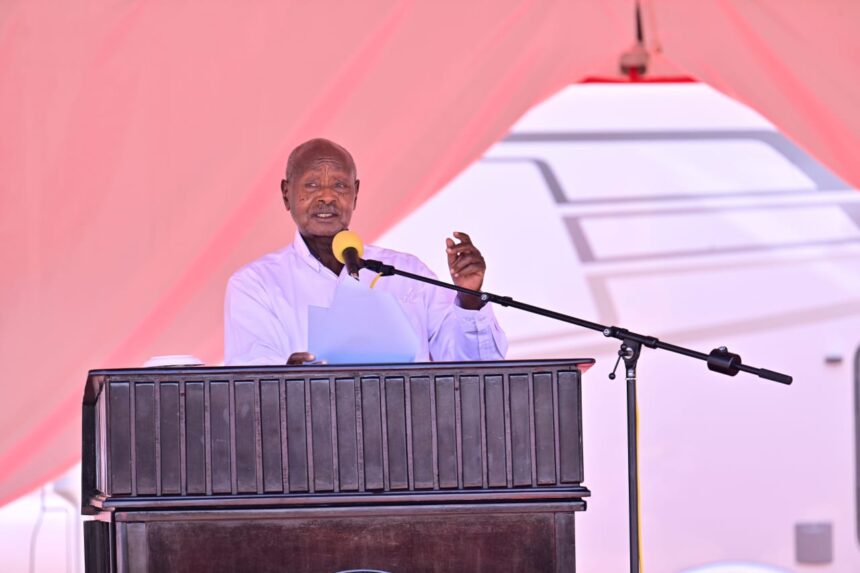
Delivering his State of the Nation Address on Thursday, June 4, 2026, at the Kololo Independence Grounds, the President placed energy, wealth creation, and industrialization at the heart of the national agenda.
Speaking to an audience of legislators, diplomats, religious leaders, and state officials—including NRM Party Treasurer Barbara Nekesa Oundo—the President outlined an ambitious vision to expand Uganda’s electricity generation capacity to 50,000 megawatts (MW) in the coming years. This massive energy boost, driven by the Uganda Electricity Distribution Company Limited (UEDCL), is designed to fuel industrial parks, value addition, and household income generation.
From Economic Collapse to a Seventeen-Fold Expansion
The President highlighted Uganda’s long journey to recovery from the economic devastation of the early 1980s. According to Museveni, Uganda’s Gross Domestic Product (GDP) has grown from USD 3.9 billion in 1986 to approximately USD 69.3 billion by foreign exchange methods, and USD 197.1 billion under Purchasing Power Parity (PPP) measurements.
“Transformation is not a miracle. It is a result of deliberate planning, production, and wealth creation,” Museveni emphasized.
Local Government Permanent Secretary, Mr. Ben Kumumanya, echoed these sentiments, noting that the economy has undergone one of the most significant structural transformations in Uganda’s post-independence history.
“In simple terms, our economy has expanded seventeen times over the last forty years,” Kumumanya stated recently, emphasizing the scope of Museveni’s economic stewardship.
Uganda’s Key Socio-Economic Indicators (1986/1992 vs. 2026)
| Indicator | Past Figures | Current Figures |
| GDP (Foreign Exchange) | USD 3.9 Billion (1986) | USD 69.3 Billion |
| GDP Per Capita | Sub-Threshold | USD 1,278 |
| Household Poverty | 56.4% (1992) | 16.1% |
| Life Expectancy | 43 Years | 68 Years |
| Infant Mortality (per 1,000 live births) | 122 Deaths | 36 Deaths |
Government projections indicate that the economy will grow by 6.4% during the current financial year before accelerating to approximately 10% in the next financial year. If achieved, Uganda’s economy will approach the USD 80 billion mark even before commercial oil revenues begin flowing into government coffers.
Furthermore, Uganda has added 31 new products to its export basket over the last 15 years. The country now exports pharmaceuticals, refined gold, steel products, ceramics, plastics, ICT products, and processed agricultural goods. Uganda’s export earnings reached an estimated USD 18 billion in the 12 months ending March 2026.
The Dairy Revolution
One of the most vivid examples of growth cited by the President is Uganda’s booming dairy sector. When the National Resistance Movement (NRM) took power in 1986, Uganda produced a meager 200 million liters of milk annually. Today, annual production stands at an estimated 5.4 billion liters.
This dairy revolution has allowed Uganda to save about USD 1.56 billion previously spent on dairy imports, while generating roughly USD 285.4 million in export earnings.
Decades ago, Uganda relied on condensed milk from New Zealand, packaged milk from Kenya, and butter, cheese, and milk powder from Europe. Today, Uganda exports these exact same commodities to regional and international markets.
However, Museveni challenged farmers within the cattle corridor to modernize livestock farming, urging them to abandon traditional free-range grazing in favor of pasture development and indoor zero-grazing technologies to maximize yield per acre.
Powering the Next Chapter
As Uganda prepares for commercial oil production and rapid industrialization, electricity remains the engine designed to power the nation into its next chapter.
With a 50,000MW generation target, expanding exports, and millions of households transition from subsistence to commercial farming, government leaders argue that Uganda is steadily positioning itself as a highly competitive middle-income economy.
Whether through a dairy farmer in Kiruhura, a coffee grower in Masaka, or an industrialist in a business park, Museveni’s message was clear: Uganda’s future relies on production, power, and the capacity of citizens to generate sustainable incomes. For a nation that once faced economic collapse, the focus has shifted from mere recovery to how fast it can convert growth into shared prosperity.
Do you have a story in your community or an opinion to share with us: Email us at Submit an Article