Since Uganda Independence in 1962, Uganda’s political journey has been marked by profound social, political, and economic transformations. From the first Parliament to the current 11th Parliament of the Republic of Uganda, the country has witnessed different leadership styles within the legislative arm of government. Some Speakers have earned admiration for their resilience, fairness, and statesmanship, while others have attracted scrutiny from both citizens and international observers.
Among the Speakers whose legacy continues to attract praise are James Wapakhabulo, Francis Ayume, and Rebecca Kadaga. Their leadership styles, though different, shared one thing in common a perception that they placed institutional integrity above personal prominence.
Kadaga, in particular, made history when she became Uganda’s first female Speaker in 2011. Her rise to the helm of Parliament was not merely symbolic; it inspired many young women across the country by demonstrating that leadership positions previously dominated by men were within reach for the girl child. As the African proverb goes, “When a woman climbs a hill, she leaves a path for others to follow.”
A Leadership Transition Marked by Loss
Uganda’s parliamentary leadership experienced a tragic transition in 2022 with the passing of Jacob Oulanyah, a respected legislator who had defeated Kadaga in a highly contested Speakership race in 2021. Oulanyah was widely regarded as a calm and measured leader who possessed a deep understanding of parliamentary procedure.
His tenure, however, was short-lived. Many Ugandans believed he had the temperament and experience to shape a new parliamentary culture, but fate had other plans. As the saying goes, “Man proposes, but God disposes.”
His death ushered in his deputy, Anita Among, to assume the Speakership. Her rise was notable for several reasons. She had previously been associated with the Forum for Democratic Change before joining the ruling National Resistance Movement (NRM). Her swift ascent within Uganda’s political hierarchy demonstrated both ambition and political adaptability.
Assessing the 11th Parliament
Supporters of Among argue that her tenure has been productive in terms of legislative output. Indeed, the 11th Parliament passed a number of notable bills, including the controversial Anti-Homosexuality Act 2023, which generated intense debate both domestically and internationally.
Parliament also introduced the concept of regional sittings, beginning with a session in Gulu in Northern Uganda. The idea was to bring Parliament closer to the people and promote regional inclusion. However, critics questioned the cost-effectiveness of the initiative, arguing that only one such sitting materialized while public expectations had been raised for similar sessions in other regions.
This raises an important question often asked in governance circles: “Is legislative success measured by the quantity of laws passed, or by their quality and impact”?
Controversies and Public Perception
Like many public leaders, Among’s tenure has not been without controversy. She has faced allegations of corruption from foreign governments, including sanctions imposed by the United States Department of the Treasury. The Speaker has consistently denied wrongdoing, arguing that the sanctions were politically motivated and linked to Uganda’s position on the Anti-Homosexuality Act.
Domestically, critics have also raised concerns about parliamentary expenditure and the lifestyle of some legislators. The debate surrounding the service award for Members of Parliament further intensified public scrutiny of Parliament’s financial priorities.
In politics, perception can be as powerful as reality. As the old saying goes, “A leader must not only be clean, but must also appear clean.”
The Role of the Deputy Speaker
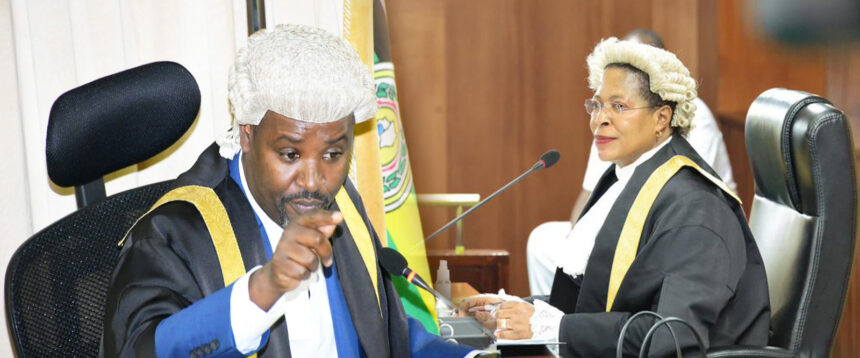
Alongside Among stands her deputy, Thomas Tayebwa, who has also played a visible role in parliamentary leadership. Tayebwa is often seen as energetic and articulate, and he has chaired several parliamentary sessions in the Speaker’s absence.
Together, the duo represent the face of the current parliamentary leadership heading into the anticipated 12th Parliament.
Their recent unopposed victories in parliamentary elections provided them with time to engage in political mobilization activities within the ruling party. Many analysts believe their efforts contributed to the strong performance of H.E Yoweri K. Museveni in the most recent electoral cycle.
This political capital partly explains why the top leadership of the National Resistance Movement has endorsed their candidacy for the Speakership and Deputy Speakership in the upcoming Parliament.
The Political Equation
Within Uganda’s political system, the ruling National Resistance Movement plays a decisive role in determining parliamentary leadership because of its numerical strength in the House.
Their recent endorsement by the party’s top leadership reflects political confidence in their stewardship.
However, history shows that public trust cannot be secured through party endorsement alone.
As an African proverb warns, “You cannot hide smoke when the house is burning.”
Citizens increasingly expect Parliament to address bread-and-butter issues such as unemployment, service delivery, corruption, and the rising cost of living.
Winning Back Public Confidence
The question therefore remains: Can Anita Among and Thomas Tayebwa win back the hearts of Ugandans in the 12th Parliament?
The answer lies not in political rhetoric but in action.
If the leadership of the next Parliament focus on: Strengthening oversight over public spending, Encouraging open debate rather than suppressing dissent, passing laws that directly improve citizens’ livelihoods, demonstrating transparency in parliamentary administration, then public trust could gradually be rebuilt.
After all, leadership is ultimately measured not by how loudly one speaks but by how effectively one serves.
As the saying goes, “The tree is known by its fruit.”
Final Reflection
Uganda’s Parliament has evolved through many phases since independence, moments of courage, moments of compromise, and moments of controversy.
Whether the next chapter becomes one of restoration or further division will largely depend on the choices made by its leaders.
For Rt. Hon Anita Among and Thomas Tayebwa, the 12th Parliament may well become their defining test.
History, after all, is written not by intentions but by outcomes.
For God and My Country.
Phillip Robert Ongadia – NRM mobilizer
Do you have a story in your community or an opinion to share with us: Email us at Submit an Article