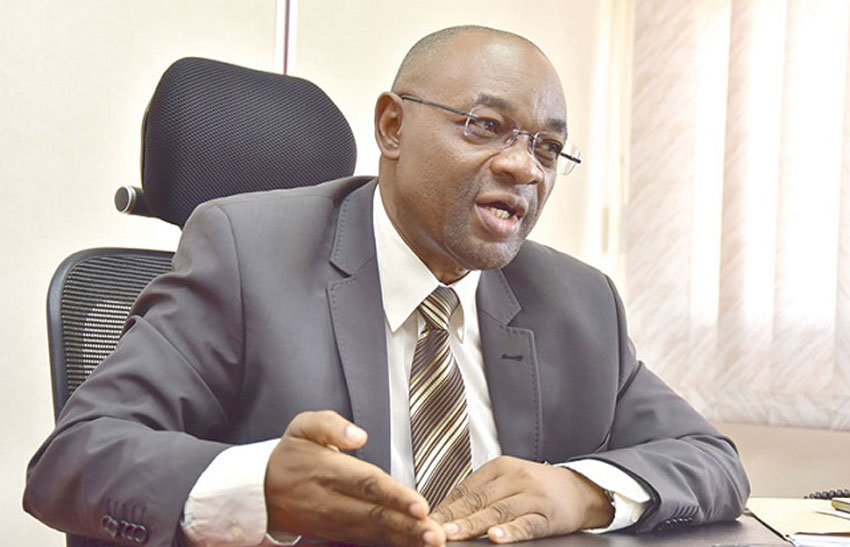
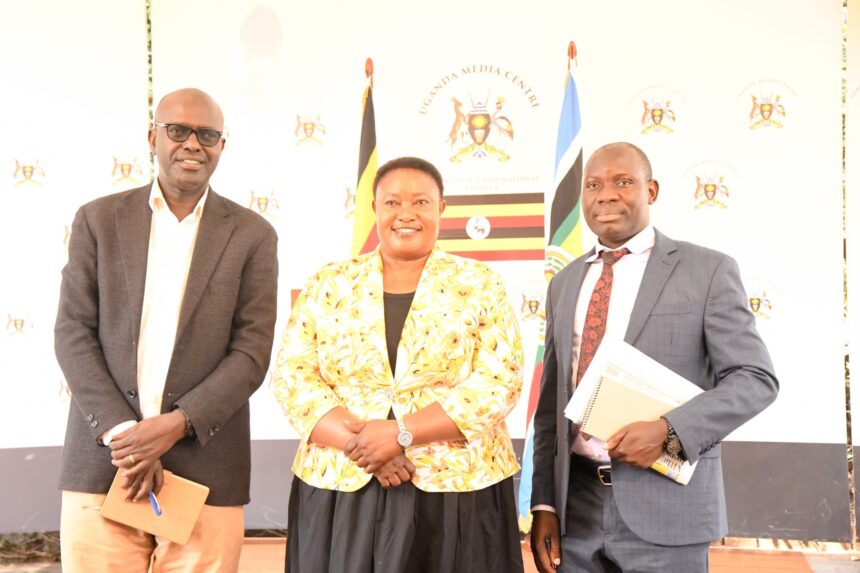
The Minister for the Presidency and MP-Elect for the Budiope West Constituency, Hon. Babirye Milly Babalanda, has today unveiled the arrangements for the 40th NRM/A Liberation Day Celebrations.
Speaking to the media at Uganda Media Centre, Minister Babalanda informed the public that anniversary celebrations will be held on Monday, 26th January 2026, at the Kololo Ceremonial Grounds under the theme: “Tribute to The Patriots who ushered in a fundamental change”.
The minister informed the media that the ceremony will be officiated by His Excellency Yoweri Kaguta Museveni, President of the Republic of Uganda, as the chief guest, who will be accompanied by many distinguished guests from both within the country and the rest of the world.
The minister noted that this year’s celebrations will be unique because the celebrations are happening at a time when the NRM presidential candidate, H.E. Rtd Gen. Yoweri Kaguta Museveni, has just been voted into the Office of the President for another term with a resounding win of 71%. “This is a real vote of confidence in the great works he has offered to his motherland, Uganda.”
“I therefore take the opportunity to heartily congratulate the President, the Members of Parliament and all the local leaders who have been elected into office for the 2026-3031 term. Congratulations!” She said.
“This year’s celebrations will be marked with a special military parade by the Uganda People’s Defence Forces (UPDF), the Uganda Police Force, the Uganda Prisons and the Uganda Wildlife Force. There will be other forms of entertainment befitting this momentous day.”
“President Yoweri Kaguta Museveni will, on this occasion, confer different categories of medals to 33 Ugandans. These are distinguished Ugandans who have made sacrifices for their motherland in various ways, enabling it to reach its current state, she said.
Minister Babalanda also provided a brief history of the 26th January Liberation Day and explained the reasons why it is worthy of celebration.
“The 26th of January is the day the gallant NRA fighters captured Kampala, ending the rule of the UNLA junta, which was led by the late Gen. Tito Okello Lutwa. The leader of the NRA fighters, Yoweri Kaguta Museveni, was subsequently sworn in as Uganda’s 9th President.”
“The revolutionary leader Yoweri Kaguta Museveni defeated the fascist regimes that had degenerated Uganda into a failed state.”
“While swearing-in at the courtyard of Uganda’s Parliament, Yoweri Museveni promised a fundamental change for Uganda in the famous statement that I quote here: ‘No one should think that what is happening today is a mere change of guards: it is a fundamental change in the politics of our country.'”
“This is a famous quote by President Yoweri Kaguta Museveni from his 1986 inauguration speech. It signified a deep ideological shift in Uganda’s politics, promising new governance, democracy, and development. It was far greater than just a typical transfer of power often seen in African nations. The phrase is a cornerstone of the NRM’s narrative, representing a transformative vision for Uganda.”
“From Independence to 1986, Uganda had changed leaders eight times; all were removed from office by either violent coups or wars.”
“This, of course, slid the country into total anarchy, which collapsed the economy to ground zero. Thousands of Ugandans were killed, others were displaced, and many ran into exile.”
“Forty years later, the general security situation in the country is now calm, and the national borders are secure save for the spillover effects resulting from conflicts in the Eastern Democratic Republic of Congo, South Sudan, Sudan and Somalia. The effects include an influx of refugees and asylum seekers, illegal immigrants and the proliferation of small arms and light weapons.”
“Uganda’s economy remains strong and resilient. It was recently ranked seventh, by the International Monetary Fund (IMF), among the nine fastest-growing economies in the world.”
“When the NRM took power, it embarked on the rehabilitation of the economy and adopted the policies of liberalisation and reformation of the public institutions. As a result, the revenue collection capacity has improved.”
“In 1986 the entire country was supplied by only one hydropower station, Nalubaale (formerly called Owen Falls Dam), with a maximum capacity of 150 megawatts.”
“There are now four (4) large hydropower plants at Nalubaale, Kiira, Isimba and Karuma, with a combined generation capacity of 1,163.2 megawatts. Other sources, such as Kigwabya, Nkonge solar power in Mubende, etc., have added another 888.8 megawatts. This brings the total installed electricity generation capacity to 2,052 megawatts.”
“On the other hand, the government continues to focus on providing excellent health services to all Ugandans. The prevention strategy remains the most powerful tool for fighting diseases. The government has invested in a number of health infrastructure projects, including the iconic Uganda Cancer Institute with 38 regional cancer centres, the Uganda Heart Institute and intensive care units and imaging centres for referral hospitals.
“Regarding education, the NRM government has implemented significant education reforms and achieved several milestones since 1986. Government has focused on increasing universal access to education at all levels.”
“Universal Primary Education (UPE) was introduced in 1997. UPE abolished school fees and dramatically increased primary school enrolment from 2.2 million children in 1986 to over 5.3 million by 1997 and over 8 million in subsequent years. The government later introduced USE to accommodate the increasing number of UPE graduates, further expanding access to education.”
“The country, which had only one university in 1986, now has 12 public universities and many private universities across all major regions. In addition, the number of schools has increased significantly, with efforts to ensure every parish has a government primary school and every sub-county has a government seed secondary school.”
“The government has progressively increased teacher numbers and salaries across different levels of education, aiming to improve teacher attendance and motivation. A new competence-based curriculum for lower secondary education was also rolled out in 2020, shifting the focus from memorisation to practical application of knowledge.”
“As far as water is concerned, the NRM government has emphasised clean water, sanitation and environmental resources, which are major contributory factors to public health, agricultural productivity and climate change adaptation.”
“The National Population and Housing Census Report of 2024 showed that at least eight (8) in ten (10) households now have access to improved water sources
i.e., piped water, protected springs, etc.”
“Finally, the Ugandan government, through the Ministry of ICT and National Guidance, is driving digital transformation via the Digital Transformation Roadmap (2023-2027). The road map focuses on infrastructure (broadband, data centres, NITA fibre), e-government (SMS Gateway, central hosting), digital skills, innovation (NIISP, AI/big data, #4IR), and sectors like e-health/education, aiming to build a knowledge economy, reduce internet costs, and enhance service delivery.”
“The government of Uganda continues to invest heavily in our road infrastructure, railway network, Uganda Airlines and transport on our water bodies.”
The agriculture sector is continuously being supported because we are deliberate in increasing our agricultural export, and no wonder, we are now the number one exporter of coffee in Africa to the world market. This sector is crucial to us because it is the number one employer of our people. Therefore, Uganda’s transformation journey is unstoppable, and the massive gains so far attained can only be consolidated for the great good of Ugandans,” Minister Babalanda explained.
Do you have a story in your community or an opinion to share with us: Email us at Submit an Article