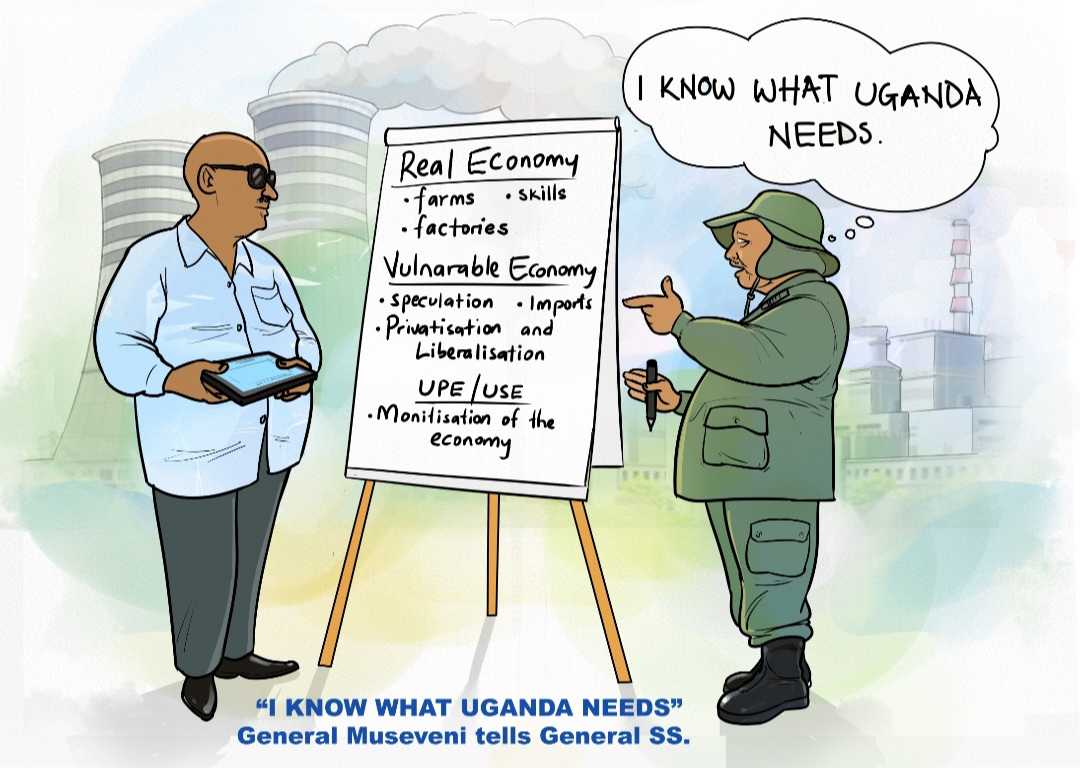
When Gen. Caleb Akandwanaho (Rtd) Salim Saleh presented his long, detailed analysis of Uganda’s economy and structured recommendations for improvement in the form of the Third National Development Plan (NDPIII) to President Museveni, he laid out the kinds of problems that many Ugandans feel every day but rarely see captured in one place.
He was doing what he has done for years: breaking down the problems holding back ordinary Ugandans. He talked about distortions in factors of production such as land conflicts that choke investment, the high cost of finance for ordinary people, the shortage of skills among youth, the slow pace of value addition, and the gap between production in the villages and the factories in industrial parks. It was the kind of diagnosis a technocrat offers when trying to get a country unstuck.
The President’s reply was striking in its simplicity: “I know what Uganda needs.”
At first, to others it might have sounded almost dismissive. But when placed in the context of 40 years of state rebuilding, economic reform, and political stability, it revealed something deeper: a belief that Uganda’s path to transformation has been consistent, deliberate, and informed by lived experience rather than theory. His confidence is not based on guesswork; it’s based on the journey already travelled.
He always stresses that any serious revolutionary discussion about the economy of Uganda or, indeed, much of Africa, should include the following questions:
What was the economy of Uganda like in 1900, at the dawn of colonialism?
What was the economy of Uganda like in 1962, at the sunset of colonialism?
How and what was the magnitude of the collapse of the Ugandan economy between 1971 and 1986 (Idi Amin, Obote II, Okello)?
What, therefore, was the economy of Uganda like in 1986?
What is the Ugandan economy like today and why?
What should the Ugandan economy be like when our country is a fully modern economy?
Modern economics talks of the five factors of production: land, labour, capital, knowledge, and entrepreneurship. We should then ask ourselves, “What was the state of these factors of production at each of the five stages that we have already gone through, and what will be the state of these factors in the sixth anticipated stage?” H.E. always asks.
Few countries in Africa have undergone the kind of recovery Uganda has achieved.
Before 1900, Uganda’s economy was simple but functional, rooted in subsistence production, barter, and community trade. People produced what they ate and exchanged what they had: milk for salt, cow for land, cereals for labour. Then came colonialism and everything changed.
The economy was restructured to serve others from away: Uganda became a supplier of raw materials; coffee, cotton, copper, and the 3 Ts (Tea, Tourism and Tobacco).
By independence, 94% of our exports were raw, processed abroad, and our people remained in perpetual survival mode. Basically, the system was designed to extract, not empower.
In the mid-1980s the economy was in ruins. Banks had collapsed, factories had died, inflation was wild, and the country was working mainly for survival.
By 1986, over 90% of parastatals were loss-making, inflation had exceeded 300%, and the formal private sector had virtually disappeared. The new Government found an economy where the state owned everything but produced nothing. The treasury was empty. Wage arrears had piled up for years. The structural adjustment agenda was already being dictated by the Bretton Woods institutions across Africa. As one senior insider often recalls, “NRM did not even participate in the formation of that first economic team and cabinet, we inherited a collapsing house with the roof already caving in.”
This meant that President Museveni’s decision to liberalise, despite his own earlier socialist leanings, was not an ideological surrender but a choice between economic life and death. Uganda had run out of oxygen. Liberalisation was the life-support machine.
By returning Asian properties, compensating former owners, reopening markets, removing price controls, floating the exchange rate, and allowing private enterprise to breathe, the President rebuilt the arteries of a dead economy. These reforms revived trade, restored banking, stabilised the shilling, and attracted the first waves of investment back into Uganda.
By the mid-1990s, inflation had fallen to single digits, domestic revenues had begun to rise, and over 135 state enterprises had been restructured or privatized. Local entrepreneurs such as Mr Mulwana, Oscar Kiwanuka, Ssembule, Wavamuno etc and foreign entrepreneurs — finally had room to operate and flourish. Export volumes recovered. Manufacturing rebounded. The private sector re-emerged as a real engine of growth rather than a shadow economy.
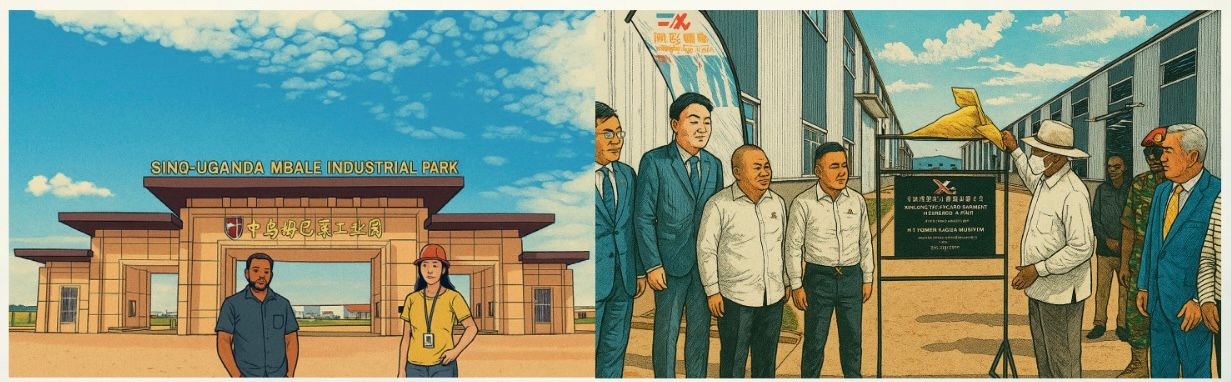
This is the foundation upon which today’s 5,000+ factories, industrial parks from Namanve to, Mbale, Soroti, Kapeeka, and a steadily growing Ugandan middle class stand. The revival of the Uganda Development Bank (UDB), the rebirth of the Uganda Development Corporation (UDC), the growth of the banking sector, and the explosion of telecoms, agribusiness, steel, cement, pharmaceuticals, coffee processing and ICT are all downstream effects of those early decisions. This liberalisation was the oxygen that brought Uganda back to life, the pivot that made every subsequent reform possible.
Today, the picture is dramatically different.
According to the latest official figures, Uganda’s economy has expanded to UGX 226.3 trillion — roughly USD 61.3 billion — up from USD 53.9 billion just a year earlier. Real GDP grew by 6.3%, placing Uganda among Africa’s fastest-growing economies. Inflation remains low and stable, hovering between 3.5% and 3.9%, a far cry from the double- and triple-digit waves that once erased people’s savings. The Uganda Shilling is now one of the most stable currencies on the continent, supported by strong export receipts, resilient remittances, and rising foreign investment. Over USD 3 Billion is expected in the next FY driven primary by Oil and Gas Investments. Per-capita income has reached USD 1,263, putting the country firmly on the threshold of lower-middle-income status.
For ordinary Ugandans, these numbers mean something practical: money holds value; markets are predictable; the currency is stable; the economy is not collapsing. They mean that a PDM farmer can plan, a trader can stock goods, and a youth with some savings can take a small gamble on a business. But these achievements also hide a deeper truth — one that H.E. Gen. Museveni keeps pointing out.
Uganda’s biggest challenge is no longer growth. The real challenge is sustained quality transformation. Many Ugandans, about 17% of the population, still work for “the stomach only” and mostly in agriculture, yet the sector contributes far less to national output. The reasons are well known: low productivity, limited mechanization, erratic markets, and most importantly, land insecurity. H.E. Gen. Museveni often asks a simple question: “How do you modernize people who are not secure on the land they use?” Too much land is locked in customary systems, Bibanja disputes, overlapping claims, Mailo confusion, or missing titles. Without secure land, households cannot borrow, factories cannot expand, and farmers cannot shift from subsistence to market production.
This is why the President describes Uganda’s land system as “a bottleneck of history” — something inherited, not created, but something that must now be fixed. In practical terms, it means a widow in Luweero being able to get a loan for a dairy shed, a cooperative in Ibanda using its titled land to expand a cooling plant, or a youth group in Gulu securing a space for a grain mill. Land becomes capital, not conflict.
Across his many speeches, from NRM CEC meetings to international summits to recent ones at the acceptance of the Presidential Candidate nomination for NRM—President Museveni returns to one central idea: wealth comes from production, not talk. He draws a firm line between the “real economy” (farms, factories, skills, science, and exports) and the “vulnerable economy” (consumption, imports, speculation, and political noise). That distinction has shaped nearly every major reform of the last two decades.
Programs like NAADS, Operation Wealth Creation, Emyooga, and now the Parish Development Model and other wealth-creation initiatives and funds are not random or scattered interventions. They are stages of one long six-decade push to end “working for the stomach” and move every household into commercial production and therefore the money economy.
This fight began when Museveni was still a young man in Ankole, struggling to convince his own people to abandon nomadism and embrace settled, commercial agriculture. As he has often said, “How can a family prosper when it keeps only cattle for prestige and not for income?” That early battle with the Ankole mindset became the template for his national economic philosophy: defeat subsistence or remain trapped in poverty forever.
When NRM took power in 1986, over 80% of Ugandan households were fully subsistence, producing only what they ate and selling almost nothing. In some regions like Karamoja, the figure was above 90%. Subsistence was not just an economic problem; it was a very serious national structural trap. The long march to monetization began in the 90s with revival of cooperatives and other targeted agricultural initiatives which led to the formation of NAADS in the early 2000s. This introduced modern farming inputs, extension services, and improved seeds. Operation Wealth Creation later expanded that mission, pushing inputs deeper into villages and millions of households.
Emyooga has been targeting the informal sector, bringing artisans, boda riders, welders, and market vendors into finance and savings. And the Parish Development Model, the most ambitious of all, seeks to commercialize all 10,694 parishes, turning each into a local production and enterprise unit.
Today, the results are visible. The share of households stuck in pure subsistence has fallen from 68% to below 17%, according to recent estimates and in some districts even lower. Millions now participate in SACCOs, sell to markets, process produce, or use micro-capital to start enterprises that simply did not exist before.
This sustained war on subsistence is the backbone of Museveni’s economic thinking: no country can modernize when its people work only for survival.
The famous “4-acre model” is simply a household version of the same doctrine: diversify, commercialize, and stabilize cash flow. Industrial parks in Namanve, Kapeeka, Mbale, Jinja, and Soroti were built to link farmers to factories. The big push for value addition in coffee, dairy, fruits, cassava, steel, and pharmaceuticals follows President Museveni’s blunt warning: “Africans hemorrhage money by exporting raw materials. Add value!”
Coffee is perhaps the clearest example. The distribution of hundreds of millions of seedlings is not just about boosting harvests; it’s about building an industry.
When Uganda roasts, grinds, packages, and exports branded coffee instead of raw beans, more money stays at home, jobs multiply, and farmers earn more. It is the same logic behind the push for agroindustrial zones and the revival of development banks like the Uganda Development Bank (UDB) and the Uganda Development Corporation (UDC) to provide patient, affordable capital.
It’s the same approach that guided UPE and USE. Bonna Basome was never a social giveaway; it was an economic equalizer designed to overhaul Uganda’s human capital. Universal Primary Education now enrolls more than 8.8 million learners, and USE/UPPET brings another 2.2 million students into lower secondary — the largest mass-education expansion in East Africa. By putting millions of children into classrooms, the NRM broke the back of Uganda’s historic skills deficit. This surge in literacy is what later made Technical and Vocational Education and Training (TVET), Information and Communications Technology (ICT), modern universities, skilling hubs, and specialized oil and gas training possible.
As President Museveni often puts it bluntly: “You cannot modernize with an uneducated population.” Education became the pipeline through which the real economy would be staffed — engineers for dams and oil pipelines, technicians for factories, scientists for laboratories, coders for the digital economy, agronomists for the PDM enterprises, and disciplined workers for a modern industrial state.
This is where NRM has a bit of a silly problem. Good policy does not survive if people cannot see its benefits. When schools, roads, clinics, and factories become normal, people stop viewing them as achievements.
They become background noise. And in that silence, other voices, often angry, misleading, or opportunistic fill the space. That is why the current campaign to “protect the gains” is not propaganda, but translation. It seeks to show how reforms touch real lives: a land title becoming a loan; a youth using a SACCO to buy equipment; a farmer selling processed, not raw, produce. Gen. Saleh’s detailed economic analysis helps diagnose the problem. President Museveni’s reply sets the direction: reduce the cost of doing business, skill the youth for current needs, push value addition, expand markets, and keep the peace that underpins everything. Uganda will reach middle-income not because of one speech or plan, but because farms become factories, titles become collateral, youth become skilled workers in oil and gas, and every household moves from survival to production. After four decades of rebuilding and reform, the President’s words carry the weight of experience: “I know what Uganda needs.”
Gen. Museveni’s claim that he “knows what Uganda needs” comes from the vantage point of a leader who helped rebuild the very foundation on which the country now stands: peace restored after decades of turmoil, a stable macro-economy, a revived and liberal private sector, functioning banks, rising industries, increasing educated population, and a growing pan- African market through the East African Community (EAC), COMESA, and the AfCFTA. But he also knows what remains unfinished. Millions of households are still producing far below their potential. Mindsets especially about land, work, and modern farming are slow to shift. As he often warns on his countrywide tours with characteristic bluntness: “We have moved, but we have not yet reached.”
Gen. Saleh’s long, meticulous diagnosis mapping of the bottlenecks in detail should continue . For forty years, Museveni has drawn the ideological map while Gen. SS has cleared the operational path , one defining the direction, the other unblocking the bottlenecks of history. This partnership is not poetic; it is the lived architecture of Uganda’s recovery.
President Museveni’s response sets out the next steps with unusual clarity: reduce the cost of doing business so that enterprise can breathe; skill the youth for the demands of today’s economy, not yesterday’s; push value addition in agriculture, Minerals and industry; expand markets across the region and the whole of Africa and most importantly keep the peace that underwrites everything.
Uganda will reach middle-income status not because of one policy or one speech, but because farms will become factories, land titles will become collateral, youth will become technicians, coders, welders and oil-and-gas workers, and every household will shift from survival to production.
After four decades of rebuilding and reform, his certainty carries the weight of experience. When he tells Gen.SS , “I know what Uganda needs,” it is not bravado—it is doctrine, distilled from six decades of struggle, study and statecraft.
The road ahead is challenging but clear: finish what has been started, close the last bottlenecks, and protect the gains.
Do you have a story in your community or an opinion to share with us: Email us at Submit an Article