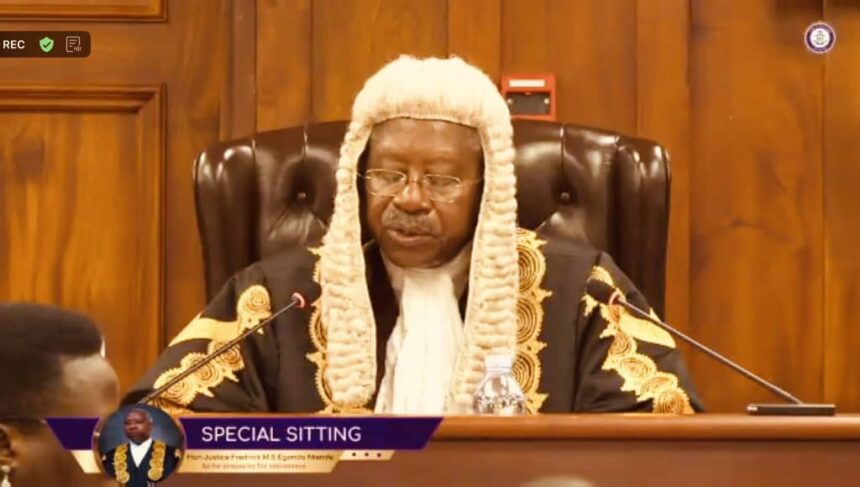
Kampala — Retiring Court of Appeal Justice Frederick Martin Stephen Egonda-Ntende has delivered a powerful and emotional critique of Uganda’s justice system, condemning what he described as the rigid and compassionless handling of the prolonged detention of National Unity Platform (NUP) Deputy Spokesperson Alex Waiswa Mufumbiro.
Speaking during a special Court of Appeal sitting on May 14, 2026, Justice Egonda-Ntende used his farewell remarks to highlight the human cost of delayed justice and prolonged pretrial detention, particularly in non-violent cases.
The 70-year-old jurist, who retires on May 26 after more than 35 years on the bench, referenced the case of Mufumbiro, who has spent over eight months on remand at Luzira Upper Prison on what the judge described as a “minor, obscure and yet unproven charge.”
Justice Egonda-Ntende emotionally recounted the tragedy that struck Mufumbiro’s family during his detention. His wife, Edith Katende Mufumbiro, succumbed to cancer on April 8, 2026, leaving their children to grieve and bury their mother without the presence of their father.
“The children were grieving and burying their mother alone without their surviving parent, a father held on some minor, obscure and yet unproven charge in the subordinate court,” Justice Egonda-Ntende stated.
“The charge did not involve loss of or threat to life, limb, property or reputation.”
The veteran judge questioned the moral implications of such circumstances, asking: “What society treats its children like this?”
His remarks drew attention to growing concerns over the use of prolonged remand detention in Uganda, especially in cases involving opposition politicians and non-violent offences.
Justice Egonda-Ntende urged the judiciary to rediscover its conscience and humanity, warning that justice devoid of compassion risks losing public trust and moral legitimacy.
He called upon judicial officers to balance strict interpretation of the law with fairness, empathy, and the broader realities faced by ordinary citizens.
The retiring justice also invoked the legacy of Uganda’s respected judicial pioneers, urging colleagues to safeguard judicial independence and ensure courts remain instruments of justice rather than procedural rigidity.
Justice Egonda-Ntende has long been regarded by legal observers and human rights advocates as one of Uganda’s most outspoken defenders of constitutionalism, civil liberties, and judicial independence.
His farewell remarks immediately sparked widespread debate within legal, political, and civil society circles, with many describing the speech as one of the most candid public criticisms of Uganda’s justice system by a sitting senior judge.
Mufumbiro, a vocal figure within the NUP party, remains in detention despite repeated bail applications. His wife’s death triggered public outrage, with NUP leader Robert Kyagulanyi, also known as Bobi Wine, criticizing authorities over the continued denial of bail and what supporters described as inhumane treatment.
The case has since reignited national debate over politically motivated prosecutions, the growing backlog in courts, and the humanitarian consequences of prolonged pretrial detention.
Supporters and human rights activists have intensified online campaigns demanding Mufumbiro’s release under the hashtag #JusticeForMufumbiro.
As Justice Egonda-Ntende prepares to officially retire from the bench, his farewell message is likely to leave a lasting impact on ongoing conversations about judicial reform, human rights, and the need for a more compassionate justice system in Uganda.
Do you have a story in your community or an opinion to share with us: Email us at Submit an Article