
President Yoweri Kaguta Museveni has renewed his long-standing economic message to Ugandans, urging citizens to focus on understanding where wealth and jobs are created.
According to the President, infrastructure development alone cannot eliminate household poverty without deliberate income generation.
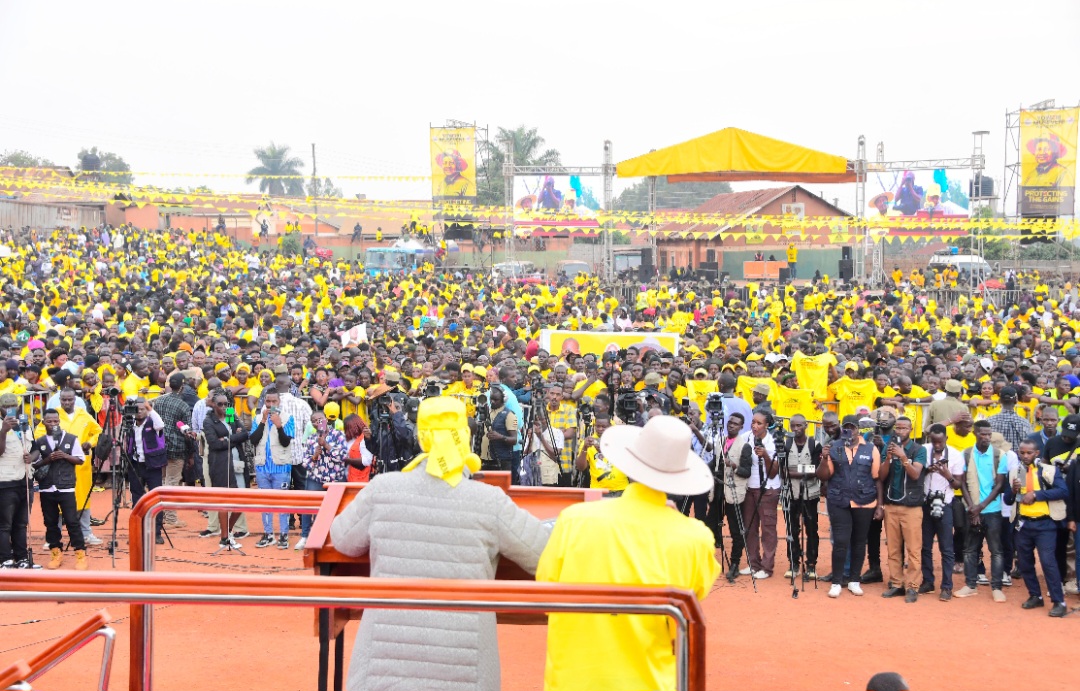
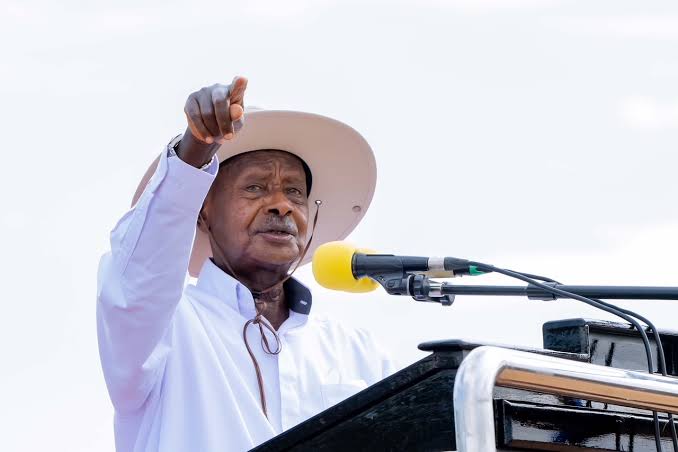
Addressing a campaign rally in Nansana Municipality on Tuesday 6th January, 2026 amid a heavy downpour, President Museveni, who is also the National Resistance Movement (NRM) presidential flag bearer for the 2026 general elections, said empowering households to generate wealth remains the central pillar of his political and economic agenda.
“I want every Ugandan to know where wealth and jobs are,” President Museveni told supporters who stood patiently in the rain.
“You may have roads, electricity, water, and other infrastructure, but if you don’t deal with wealth creation, homes will remain poor.”
The President was accompanied by the First Lady and Minister of Education and Sports, Maama Janet Kataaha Museveni, as well as senior NRM party leaders and government officials, as he continued his campaign trail across Wakiso and Kampala ahead of the 2026 polls.

President Museveni drew historical comparisons to underline his argument that infrastructure development, while important, does not automatically translate into improved household incomes.
“When we were fighting, the road from Kampala to Gulu was tarmac, but along that road there were grass-thatched houses. Almost all the houses were of mud and wattle, not bricks like today. That is why the NRM emphasised wealth and jobs.”
He stressed that Uganda’s economic transformation requires citizens to actively participate in income-generating activities rather than relying solely on government-provided infrastructure.
According to President Museveni, the NRM government has consistently educated Ugandans that wealth and jobs are primarily found in four key sectors: commercial agriculture, manufacturing and artisanship, services, and Information and Communication Technology (ICT).
On commercial agriculture, which he described as the backbone of Uganda’s wealth creation strategy, the NRM candidate revisited the four-acre model introduced in the NRM’s 1996 manifesto, explaining how smallholder farmers can generate substantial income through planned land use.
“In this model, you can have one acre of coffee, one acre of fruits, one acre of pasture for livestock, and one acre for food crops for the family,” President Museveni said.

“In the backyard, you put piggery or poultry for eggs. Those near wetlands can do fish farming.”
He argued that even households with limited land can achieve financial stability if they adopt modern agricultural practices and diversify their activities. To illustrate his point, the President cited real-life examples of Ugandans who have successfully embraced commercial agriculture.
One such example is Joseph Ijala from Serere District, a former taxi driver who now operates an integrated farm on 2.5 acres of land.
Ijala, President Museveni said, began with poultry before expanding into dairy farming. He currently keeps about 10,000 layer chickens, producing approximately 310 trays of eggs per day.
On just 1.5 acres, Ijala also practices zero-grazing dairy farming with four cows, producing up to 300 liters of milk daily. Combined, the President said, Ijala earns about Shs 6.8 million per month from eggs and milk.
President Museveni noted that such examples demonstrate how small-scale farmers can generate significant income when they embrace modern, commercial approaches.
Urban and peri-urban agriculture:
Turning to the urban setting of Wakiso District, President Museveni encouraged residents to engage in peri-urban agriculture suited to limited space.
“In areas like Wakiso, Nansana, and Matugga, you can do poultry or piggery,” he said. “You can also grow mushrooms—those are easy to do.”
He added that fish farming is another viable option for communities near wetlands and water bodies, provided environmental guidelines are followed.
The President also cited his own Barlege farm in the Lira–Lango sub-region as an example of integrated farming.
“From my fish pond of 20 meters by 100 meters, I get about Shs 100 million per year,” President Museveni said. “After removing costs, I remain with Shs 70 million. You can have two such ponds on one acre.”
President Museveni also referenced the success of Johnson Basangwa of Jeka Poultry Farm in Kamuli District as a powerful example of wealth creation translating into job creation. Basangwa, according to the President, produces up to 2,500 trays of eggs per day, earning about Shs 20 million daily, Shs 600 million monthly, and approximately Shs 7.2 billion annually.
“But the wealth of Basangwa has also created jobs for 300 people,” President Museveni said.
He recalled advising residents in Kamuli in 2007 that not everyone could become a political leader, urging them instead to pursue productive economic activities.
“The one who was fighting to become LC5 chairman is now a rich man and has created jobs for others,” President Museveni said.
Beyond agriculture, President Museveni identified manufacturing and artisanship as another critical source of wealth and employment. He pointed to the rapid expansion of industrial parks across the country, including those in Namanve, Kawanda, Matugga, and Mbale.
“You people of this area know how many factories are here now,” he said. “If you go to Mbale, you will see the Mbale-Sino Industrial Park, which employs our people.”
According to President Museveni, industrialisation not only creates direct factory jobs but also stimulates demand for raw materials, transport services, and skilled labour.
The President also highlighted the services sector as a growing source of employment, particularly for urban youth.
“Boda bodas, taxis, hotels, tourism, music, and creative arts — all these are in the services sector,” he said.
He further encouraged young people to take advantage of opportunities in ICT, noting that technology allows Ugandans to work for companies abroad while living at home.
“You can be here and work for companies in Canada or the United States and be paid while you are here,” President Museveni said.
Parish Development Model concerns:
President Museveni also addressed concerns surrounding the Parish Development Model (PDM), a flagship government programme aimed at moving households from subsistence to the money economy.
He explained that since 1997, the NRM government has implemented various wealth-creation initiatives, including Entandikwa, NAADS, Operation Wealth Creation, Emyooga, the Youth Fund, and the Women’s Fund.
“Some of these programmes were having an impact but were not reaching everybody,” he said.
President Museveni noted that although Uganda’s agricultural output has increased significantly—with coffee exports rising from three million to nine million bags and cattle numbers growing from three million to 16 million—poverty persists in some households.
Responding to allegations of misuse of PDM funds, President Museveni said reforms were introduced to ensure fairness and transparency.
“When I heard people saying some people were giving themselves the money, I said, you form a SACCO in the parish where everyone above 18 joins,” he said.
He explained that parish members now elect committees that prioritise beneficiaries per parish.
According to the President, Wakiso District has received Shs 52 billion in PDM funds, reaching about 47,000 households so far.
“If there was unfair distribution, we shall sort it out,” President Museveni said, adding that cases of illegal deductions from beneficiaries would be treated as criminal offences.
“The PDM money is sweeter than money from moneylenders,” he said, pledging to inject more funds into the programme.
Despite the persistent afternoon rainfall, thousands of NRM supporters remained at the venue, listening attentively as the President delivered his message. President Museveni commended the crowd for braving the heavy downpour, describing their turnout as a reflection of resilience and commitment.
“You have shown the spirit of freedom fighters,” he said. “You are the real children and grandchildren of patriotic freedom fighters.”
On her part, Maama Janet praised residents of Nansana for enduring the rain to listen to the NRM message.
“If you are building a house, there is a price you must pay,” she said. “Sometimes you stand in the sun or in the rain.”
Drawing a biblical analogy, she urged Ugandans not to forget their journey as the country seeks further development.
“As Uganda moves toward the promised land, we should not forget where God has brought us from,” Maama Janet said, calling on voters to turn up on January 15, 2026, and vote for President Museveni and all NRM candidates, saying continuity would ensure sustained transformation.
The rally was also attended by the NRM’s first national Vice Chairperson, Alhajji Moses Kigongo; the second national Vice Chairperson and Speaker of Parliament, Rt. Hon. Annet Anita Among, the NRM Vice Chairperson for Buganda, Hon. Haruna Kyeyune Kasolo, several members of the party’s Central Executive Committee (CEC); and a high-level delegation from Ghana.
Hon. Among thanked the President for allocating funds under the Fourth National Development Plan (NDP IV) to rehabilitate the Nansana–Busunju road.
She also appealed for the establishment of modern markets in Busukuma and Nansana to support local traders and farmers.
Do you have a story in your community or an opinion to share with us: Email us at Submit an Article