Uganda has launched a major national consultation to overhaul two key policies governing Micro, Small and Medium Enterprises (MSMEs) and national standards, in a move officials say is critical to accelerating the country’s ambition to become a USD 500 billion economy within the next decade.
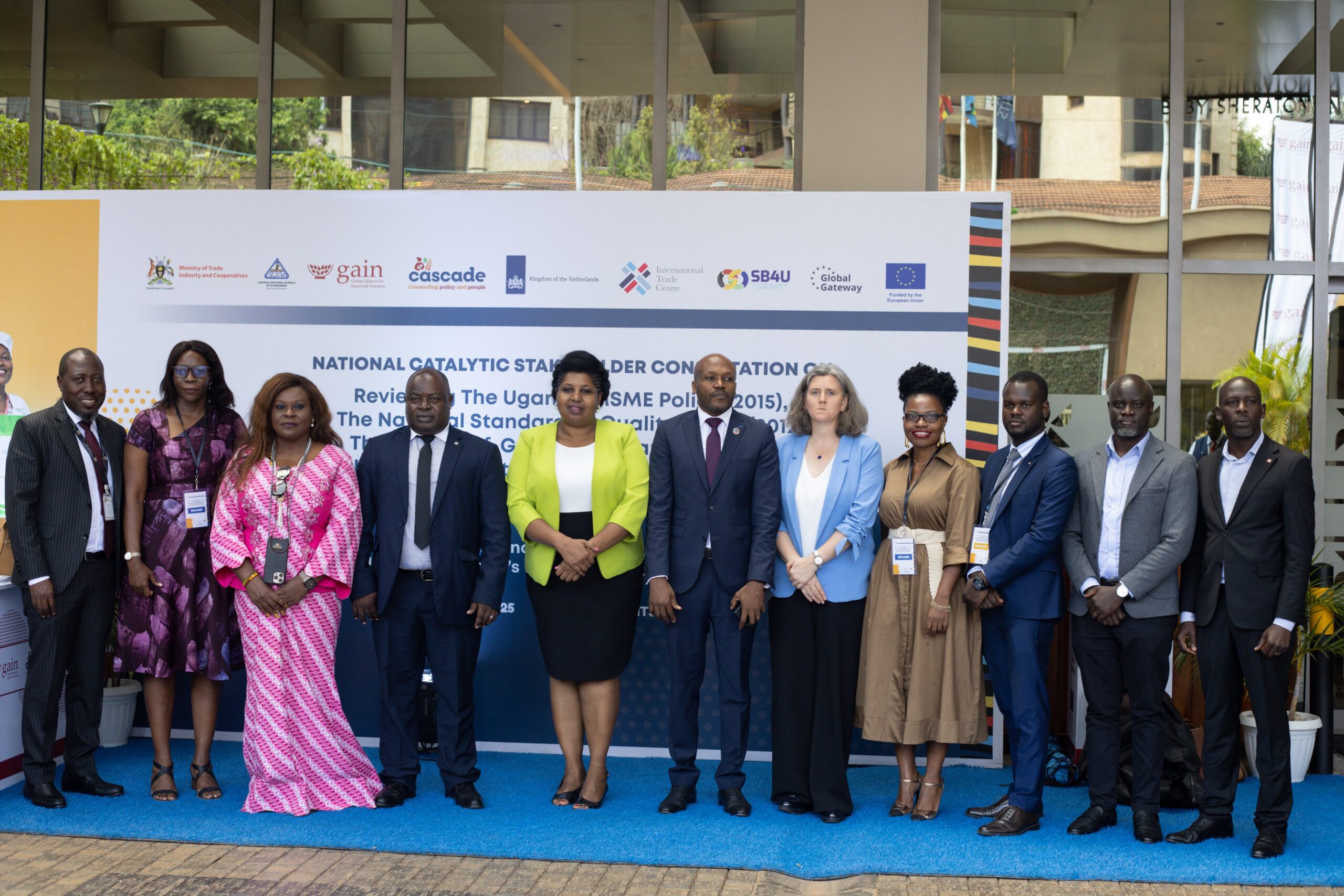
The National Catalytic Stakeholder Consultation, held on Tuesday at the Four Points by Sheraton, brought together government ministries, development partners, private-sector leaders, and MSME representatives. It also marked the official launch of the Good Governance Guidelines (GGG) for Uganda’s Quality Infrastructure Institutions, a framework aimed at strengthening performance, integrity, and accountability across the standards ecosystem.
While addressing the gathering, Ms. Damali Sali, the Country Director of the Global Alliance for Improved Nutrition (GAIN) Uganda, underscored the urgency of redesigning Uganda’s MSME and standards policies to match the country’s ambitious economic targets.
She emphasized that Uganda stands at a pivotal moment, citing the Tenfold Growth Strategy under NDP IV, which targets a USD 500 billion economy by 2030. “This convening matters because Uganda stands at a moment of opportunity. The ambitions are big, but our policies must match the realities of today’s enterprise landscape.”
Sali noted that despite being the engine of Uganda’s economy, SMEs still operate under policy frameworks developed in 2012 and 2015, which are now obsolete.
“Our SMEs, which form 98% of all enterprises and contribute 75% to the GDP, are navigating a policy environment that no longer reflects today’s challenges and opportunities,” she said.
“The gaps in our standards and MSME development policies slow enterprise growth, reduce competitiveness, and limit the quality of goods and services.”
She stressed that the consultation was not simply a technical review, but a national alignment moment.
“Today is about shifting from consultation to co-ownership. We are aligning government, the private sector, development partners, and MSMEs under one shared agenda for transformation.”
Sali highlighted GAIN’s practical experience in supporting enterprise transformation in Uganda’s food systems sector, noting: “Our work with 300 SMEs over the last three years has shown what is possible when standards, innovation, and competitiveness are nurtured intentionally.”
She explained that GAIN has delivered structured capacity building to enterprises, focusing on business development, product innovation, digital commerce, regulatory compliance, and investment readiness
“These are not theoretical conversations,” she added. “When you give SMEs the right tools, right guidance, and right partnerships, they accelerate, and that acceleration is exactly what Uganda needs for tenfold economic growth.”
Sali positioned GAIN as a connector, facilitator, and enabler: “Our role today is to bring diverse perspectives — especially the voices of MSMEs in food systems — to ensure policies are evidence-based and demand-driven.”
She urged stakeholders to take the consultations seriously:“Moments like this matter. Dialogues like this matter. Because the right partners and the right attention can turn good intentions into tangible results for Uganda’s enterprise ecosystem.”
Government: MSMEs Are the Backbone of Uganda’s Economy
Officiating the event, State Minister for Trade, Industry and Cooperatives, Gen. Wilson Mbasu Mbadi, whose speech was delivered by Under Secretary for the Ministry of Trade, Industry and Cooperatives (MTIC) Mr. Deogratius Masagazi, said Uganda’s economic future depends heavily on strengthening MSMEs.
“MSMEs form 98.8% of all enterprises; they contribute 75% of our GDP and employ 77% of our formal workforce. They are not just participants in our economy — they are its backbone,” he said.
The minister emphasized that the review of the MSME Policy (2015) and the National Standards and Quality Policy (2012) will help address long-standing challenges such as limited financing, low productivity, weak innovation, and quality-compliance gaps.
He further launched the Good Governance Guidelines, describing them as key to strengthening Uganda’s standards infrastructure.
“This Guide provides an essential governance framework to enhance integrity, accountability, and high performance across the NQI ecosystem — including standardization, metrology, certification, accreditation, and market surveillance. It aligns with global best practices and the aspirations of Vision 2040, NDP IV, the EAC Vision 2050, and the AfCFTA market integration agenda.”
Both GAIN and the Ministry highlighted the importance of multi-stakeholder collaboration in ensuring the revised policies respond to real enterprise needs.
Meanwhile, Sali echoed the minister’s call for deeper partnership and accountability: “Policy review must be inclusive, transparent, and actionable. Partnership is the only way to ensure that the outcomes we design today translate into real change for MSMEs tomorrow.”
Roadmap to a Modern Business Environment
Stakeholders are expected to produce a new roadmap for strong, modern, and inclusive policies that: directly strengthen MSMEs, raise national standards, improve enterprise competitiveness, enable sustainable industrialization, and support Uganda’s tenfold growth pathway.
Minister Mbadi reinforced the same spirit: “As we begin this important work, let us remember that inclusive policymaking is smart policymaking. Together, we can build policies that reflect our people’s aspirations and propel Uganda toward a competitive, quality-driven economy.”
Do you have a story in your community or an opinion to share with us: Email us at Submit an Article