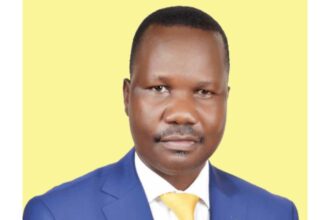
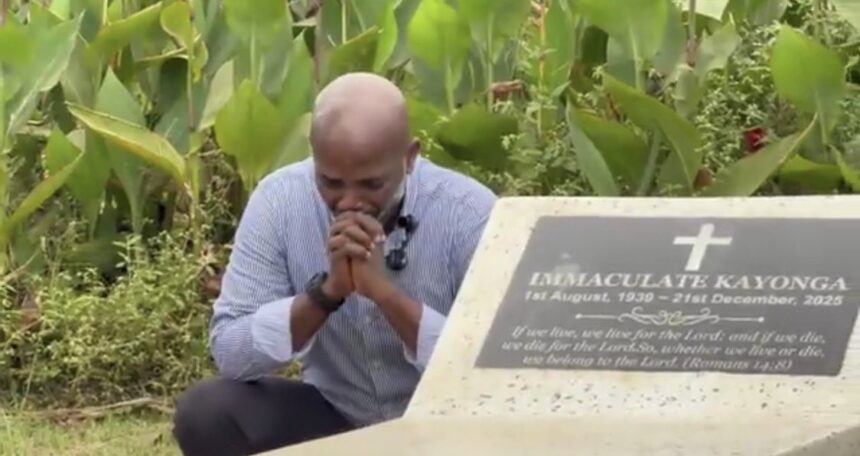
KAMPALA, Uganda – An emotional scene unfolded this week when Dr. Lawrence Muganga, the Vice Chancellor of Victoria University, broke down in tears at his late mother’s grave as he sought to reaffirm his Ugandan identity following his rejection by Parliament’s Appointments Committee.
The incident has fueled a heated national debate on citizenship, loyalty, and identity politics after Dr. Muganga’s nomination as State Minister for Internal Affairs was rejected over concerns regarding his citizenship status.
President Yoweri Museveni had nominated Dr. Muganga on May 26, 2026, as part of a wider Cabinet reshuffle. However, during the vetting process, members of the Appointments Committee raised questions about his eligibility for the sensitive ministerial portfolio, citing concerns that he holds or previously held multiple citizenships, including Ugandan, Canadian, and Rwandan citizenship.
Under Uganda’s Citizenship and Immigration Control Act, individuals holding dual or multiple citizenships are barred from occupying certain strategic public offices unless they formally renounce their foreign citizenships.
According to reports from the vetting process, committee members were not fully satisfied with the documentation and explanations presented regarding Dr. Muganga’s renunciation of foreign citizenships. While several other nominees facing similar concerns were reportedly cleared after presenting evidence of renunciation, Muganga’s case was referred back to the appointing authority for further action.
Presenting the committee’s report to Parliament, Deputy Speaker Thomas Tayebwa noted that whereas 81 of the 82 presidential nominees had been approved, Dr. Muganga’s nomination required additional consideration.
The decision effectively stalled his appointment, although President Museveni retains the constitutional authority to renominate him should the citizenship concerns be resolved.
In response, Dr. Muganga has launched a vigorous public campaign to defend his Ugandan identity. During a visit to his parents’ graves in Mukono District, he became visibly emotional, insisting that he was born in Uganda, raised in Uganda, buried his parents in Uganda, and intends to be buried in Uganda himself.
“I am a Ugandan,” he declared, while also suggesting that prejudice against Banyarwanda Ugandans may have influenced perceptions surrounding his nomination.
His supporters, drawn from both the Baganda and Banyarwanda communities, have rallied behind him, arguing that the rejection reflects selective enforcement of citizenship rules rather than a consistent application of the law.
However, critics maintain that the matter is strictly legal and constitutional rather than ethnic. They argue that anyone seeking to serve in a ministry responsible for immigration, citizenship, and internal security must demonstrate unquestionable compliance with citizenship requirements and undivided allegiance to Uganda.
Some legal commentators have also pointed out that possession of an expired foreign passport does not necessarily amount to formal renunciation of citizenship under the law.
Dr. Muganga has since indicated that he has taken steps to formally renounce any remaining foreign citizenship ties while emphasizing his contributions to Uganda’s education sector and national development.
The controversy has reignited broader discussions about the place of diaspora Ugandans in public service. While Uganda’s Constitution permits dual citizenship for ordinary citizens, stricter eligibility requirements apply to holders of certain high-ranking public offices in order to safeguard national interests.
As of June 5, 2026, the position of State Minister for Internal Affairs remains vacant pending President Museveni’s next decision. Although Dr. Muganga’s emotional appeal has attracted widespread sympathy on social media and among sections of the public, legal experts insist that his eligibility will ultimately depend on documentary compliance with the law rather than public sentiment.
The unfolding saga continues to highlight the complex intersection of citizenship, migration, identity, and public service in contemporary Uganda.
Do you have a story in your community or an opinion to share with us: Email us at Submit an Article