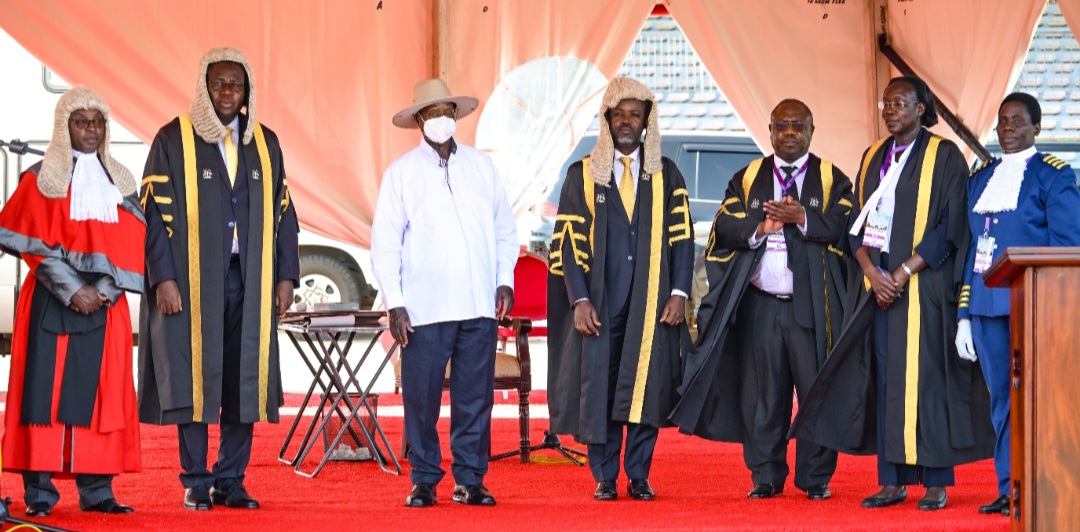

President Museveni’s new Cabinet, announced after his swearing-in earlier this month, has been received with a mixture of surprise and cautious optimism, but when one looks closely at the composition, the story that emerges is not one of stagnation but of deliberate renewal. The President has chosen to dramatize a generational shift, balancing the wisdom of seasoned figures with the energy of younger leaders, and in doing so he has crafted a team that could indeed serve as a reform base rather than a mere continuation of the past. The narrative of this Cabinet is one of transition, inclusivity, and a sharpened focus on the fight against corruption, which Museveni declared as his central commitment at the inauguration.
The departure of long-serving veterans like Matia Kasaija, Moses Ali, Ruth Nankabirwa, and Jeje Odongo was not a quiet exit but a symbolic curtain fall on an era. These figures had become synonymous with the old guard, and their absence signals a deliberate move to refresh the government’s image. Into their places stepped over thirty new faces, many of them relatively young, such as Desire Muhooza in Agriculture and Robert Ndugwa Migadde in Fisheries. This infusion of youth is not cosmetic; it is a calculated attempt to inject new energy into ministries that have long been weighed down by bureaucratic inertia. The younger ministers, unburdened by entrenched patronage networks, carry the promise of cleaner governance and a willingness to experiment with new approaches.
Yet Museveni has not abandoned continuity altogether. He retained Vice President Jessica Alupo, Prime Minister Robinah Nabbanja, and Janet Kataaha Museveni as Minister of Education. These figures provide stability at the top, ensuring that the government does not lose its institutional memory. The balance between youth and elders is therefore carefully calibrated: the veterans anchor the ship, while the newcomers adjust its sails toward reform. This duality dramatizes the tension between tradition and innovation, a tension that could prove productive if managed wisely.
Regional balancing is another striking feature of the appointments. From Kisoro in the west came Grace Kifeza Ngabirano to Defence and Veterans Affairs; from eastern Uganda, Phyllis Chemutai took Primary Education. By ensuring that each region sees itself reflected in the Cabinet, Museveni reinforces national cohesion and counters accusations of favoritism. This inclusivity is not just symbolic—it is strategic, as it strengthens the legitimacy of the government across Uganda’s diverse geography. The Cabinet becomes a mirror in which every Ugandan can see themselves, a subtle but powerful tool for unity.
The fight against corruption, Museveni’s declared priority, is where the Cabinet’s composition becomes most significant. Younger ministers, lacking entrenched networks, may be better positioned to pursue reforms. Technocrats like Adonia Ayebare at Foreign Affairs bring professional expertise that can reduce opportunities for rent-seeking. At the same time, experienced figures like Kahinda Otafiire, now at Water and Environment, provide continuity and institutional knowledge. The challenge will be whether the younger generation is empowered to act independently or whether they remain under the shadow of the veterans. If Museveni allows them genuine autonomy, Uganda could see a gradual dismantling of corrupt networks. If not, the Cabinet risks becoming another act in the theatre of promises unmet.
Among the most effective ministers in the last Cabinet was Milly Babalanda, who served as Minister for the Presidency. Her tenure was marked by efficiency, loyalty, and a clear sense of purpose. She became a trusted figure in coordinating government business and ensuring that presidential directives were implemented. Her effectiveness demonstrated that loyalty and competence can coexist, and her example sets a benchmark for the new ministers. In a government often criticized for sluggishness, Babalanda stood out as a performer who delivered results.
The posting of Kasule Lumumba to ICT and National Guidance is another strategic move. Lumumba’s track record as a loyal and disciplined party cadre, coupled with her experience in mobilization and communication, makes her well-suited for a docket that will serve as the face of the government. ICT and National Guidance is not just about technology; it is about shaping the narrative of governance, guiding public perception, and ensuring that government communication is coherent and persuasive. Lumumba’s loyalty ensures that she will align closely with the President’s vision, while her experience equips her to manage the complexities of a sector that is increasingly central to modern governance. In an era where information flows rapidly and narratives can shape political fortunes, her appointment is both symbolic and practical. She embodies the blend of loyalty and competence that Museveni prizes, and her presence in this docket could strengthen the government’s image as reformist and responsive.
Taken together, the Cabinet appointments dramatize a stage crowded with actors: veterans exiting with dignity, newcomers stepping into the spotlight, regional representatives waving flags of inclusivity, and the President himself directing the play with a steady hand. The audience—Ugandan citizens—waits to see whether this performance will end in genuine reform or in the familiar encore of promises unmet. But there is reason to be supportive. The infusion of youth, the deliberate regional balancing, the retention of effective figures like Babalanda, and the strategic posting of Lumumba all suggest that Museveni is serious about crafting a Cabinet that can serve as a reform base. The fight against corruption will be contested terrain, but the composition of the Cabinet provides tools that, if used wisely, could tilt the balance toward progress.
This Cabinet is therefore not just a list of names; it is a narrative of renewal, a tableau of Uganda’s political future where the balance of youth and elders, regions and loyalties, continuity and change will determine whether Museveni’s pledge to fight corruption becomes history or remains theatre. The optimism lies in the fact that the President has chosen to dramatize change rather than deny it, and in that choice lies the possibility of genuine reform.
The author is the Deputy Resident City Commissioner for Nakawa Division.
Do you have a story in your community or an opinion to share with us: Email us at Submit an Article