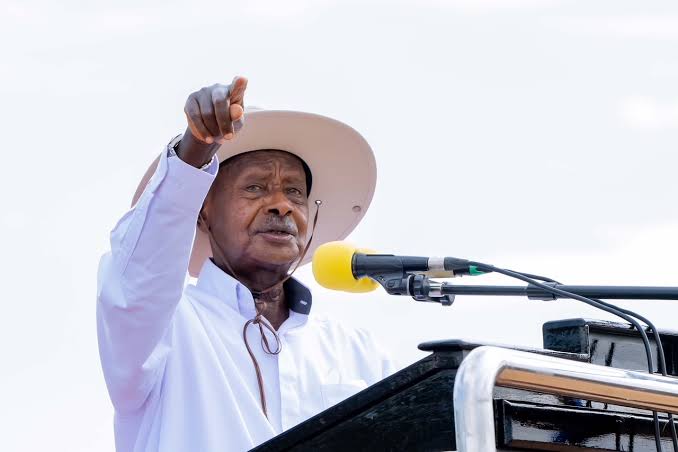
As Uganda gears up for the crucial presidential and parliamentary elections scheduled for January 15, 2026, a recent poll conducted by Public Opinions has provided a compelling snapshot of public sentiment across the country. The survey, which reached out to ordinary Ugandans in 100 districts, reveals that President Yoweri Museveni is currently leading with 62% support, a figure that many Ugandans find both realistic and appreciable.
Public Opinions, known for its commitment to community engagement, strategic engagement, diplomacy, issues research and community peace defenders ,conducted this survey over the past week through its network of community peace defenders. The results have sparked conversations among Ugandans, particularly regarding the nature of Museveni’s leadership. The report emphasizes that President Museveni, who has held power for 40 years, cannot be labeled an authoritarian leader, especially as no dictator garners less than 80% support; this makes Museveni’s 62% a significant marker of his leadership style and acceptance.
Throughout his lengthy tenure, Museveni has overseen a democracy that,according to the report, stands at approximately 75%. This is a stark contrast to many other African nations, where democratic governance is often overshadowed by authoritarian rule. The poll underscores that Ugandans enjoy freedoms such as speech, association, and the right to choose their leaders, contributing to a political landscape that, while not without its challenges, is relatively open.
The survey indicates that General Museveni, the National Resistance Movement (NRM) presidential candidate, is currently solidifying his lead. His support is particularly strong in regions such as North Ankole, Toro, Acholi, Karamoja, Teso, Bunyoro, parts of West Nile, Bukedi, Sebei, and Kigezi. Interestingly, even in the traditionally challenging Buganda region, which includes districts like Luwero, Masaka, Wakiso, and Kampala, there has been a notable uptick in support for Museveni, reflecting a broader acceptance of his governance.
Through lout his reign, he has presided over a 75% democratic State. Many African countries are at just 10% democracy and 90% authoritarianism. Museveni has allowed people to enjoy freedom of speech and Association, and freedom to choose their own leaders.Indication on Ground showed that Museveni support is raising and steadfast and may rise beyond 62% basing on last minute NRM out reach to its voters and depending on NRM capacity to ensure that people turn up to vote.
National Unity Platform candidate Robert Kyagulanyi is leading the opposition candidates with 33% basing on voices of voters in villages on 100 districts of Uganda. The next is Hon nandala mafabi of the FORUM for democractic change followed by Mugisha muntu.Museveni will get more votes from women, elderly followed by the youth.
Museveni’s success in the polls can be attributed to several factors, chief among them being his commitment to maintaining peace and security during the election campaign. The survey highlights that Ugandans appreciate his efforts in fostering an environment of minimal violence and conflict, which has allowed for peaceful campaigning. Many respondents acknowledged Museveni’s calm demeanor and humility throughout the election season, characteristics that resonate well with the electorate.
Another significant aspect of Museveni’s campaign is his focus on wealth creation and poverty eradication, steering clear of divisive political rhetoric. His approach to engage with religious and cultural leaders has further bolstered his standing among various demographics. Most importantly, Museveni’s outreach to the vulnerable youth, promising them opportunities and a brighter future, has garnered substantial support from this crucial voting bloc.
However, challenges remain. The state must ensure a peaceful election process while combating voter apathy. Concerns over poor communication and corruption—especially regarding funds meant for local NRM initiatives—pose potential hurdles that could affect voter turnout and overall election integrity.
The survey also sheds light on the sentiments in the Busoga subregion, where discontent is not solely directed at Museveni but rather stems from internal conflicts among regional leaders and longstanding poverty issues. Despite this, Museveni’s reputation as Uganda’s Peace and Development Champion is solidified by his investments in infrastructure, healthcare, and energy, notably through hydroelectric projects that have improved living standards.
Additionally, Museveni’s adept management of Uganda’s foreign relations has fostered strong global alliances, further enhancing his image as a leader committed to stability and peace. As the election date approaches, it is expected that Museveni will continue to garner support from women, the elderly, and the youth, reflecting a broad coalition of backing as he aims for another term in office.
This community-driven survey, conducted by Public Opinions, underscores the evolving political dynamics in Uganda and highlights President Museveni’s adaptability and resilience in the face of challenges. As the nation prepares for the upcoming elections, the landscape remains complex, yet the support for Museveni appears to be firmly entrenched, setting the stage for what promises to be a significant moment in Uganda’s political history.
This survey was conducted by the community Peace defenders managed by Public Opinions the leading field-based organisation dedicated to diplomacy and international relations, issues research, public awareness and information dissemination.
Do you have a story in your community or an opinion to share with us: Email us at Submit an Article