The Secretary Office of the President, Hajji Yunus Kakande has congratulated the Resident District Commissioners (RDCs) in the West Nile Sub-Region for the role they played during the 2026 general elections.
“Your mobilization efforts, vigilance and coordination ensured stability in the West Nile Sub-Region and contributed significantly to the victory of His Excellency Yoweri Kaguta Museveni and the NRM Flag bearer,” he said.
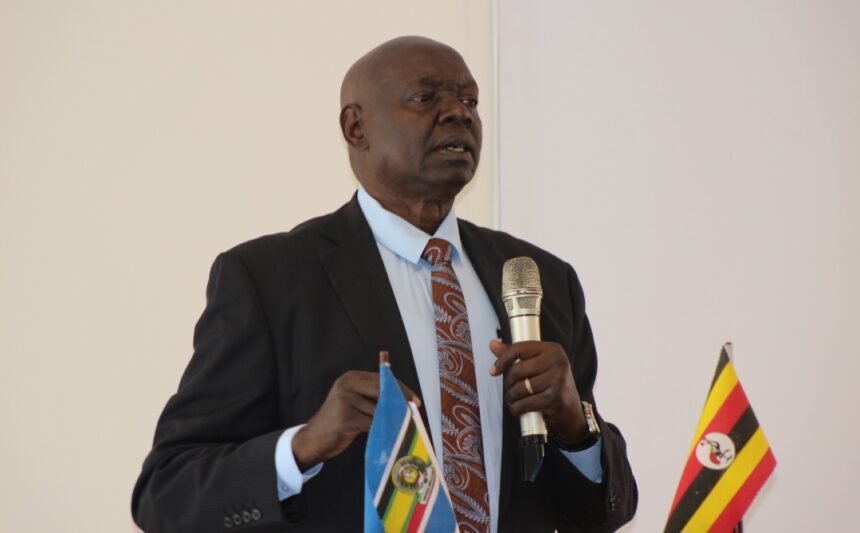
Hajji Kakande made the remarks on Friday 27th February, 2026 through his message delivered by the Senior Presidential Advisor In-charge of Mobilization, Lt. Col. (Rtd), Kibrai Ambako, during the closure of a 3-day capacity building workshop for RDCs/RCC, Deputy RDCs/RDCs, Asst. RDCs/RCCs, RISOs, and DISOs in the West Nile sub-region, held at Hotel Le Confidentiel, Arua.
He also explained that RDCs are central pillars of governance at the district level since they’re representatives of the President in the districts, supervisors of government programs, coordinators of central government agencies and guardians of lawful administration.
“And for DISOs, you’re the Custodians of internal security intelligence, early warning systems for threats to peace and stability and advisors to RDCs on security trends and preventive action,” Hajji Kakande noted.
“Therefore, the synergy between RDCs and DISOs is critical. Development cannot thrive without security, and security cannot be sustained without development.”
Hajji Kakande noted that apart from representing the President, the RDCs day-to-day duties include the monitoring and supervision of public service delivery in their respective areas of jurisdiction, highlighting that monitoring is not a ceremonial or optional function however, it is the backbone of accountability and the foundation upon which effective governance is built.
“You can all testify that indeed, the Government has invested substantial resources in critical sectors such as infrastructure, education, health services, wealth creation programs, and initiatives like the Parish Development Model and other livelihood interventions. Without active and diligent monitoring, these resources risk being misused, projects may stall and public confidence in government can erode,” he said.
“Ladies and Gentlemen, It is therefore through your consistent oversight that projects can be completed on schedule, quality standards are upheld, service providers are held accountable, and the wananchi receive tangible value from public investments.”
On the other hand, Hajji Kakande urged the participants to diligently document their field findings, follow up on corrective actions, and maintain professional and accurate records of their activities.
“Evidence-based reporting is critical because it informs decision-making at the center and ensures that interventions are timely, targeted, and effective.”
He further cautioned them against working in isolation, saying that one cannot succeed if he/she does so.
“You must work harmoniously with:Chief Administrative Officers, District Chairpersons, Technical staff, Security committees and the Community leaders. This coordination prevents duplication, reduces conflict and enhances efficiency,” he said.
“Let us avoid unnecessary friction between political and technical leadership. Our common objective is to ensure that services reach the wananchi effectively and equitably. Teamwork must also extend among yourselves—RDCs, DRDCs, ARDCs, RISOs and DISOs. Share intelligence, share strategies, and support one another.”
Additionally, Hajji Kakande warned the RDCs that infrastructure alone does not guarantee prosperity among the citizenry, asserting that true transformation occurs when every homestead becomes a productive economic unit, capable of generating sustainable income and improving livelihoods.
“This particular aspect was properly emphasized by H.E the President during the campaign tours in all the sub-regions of Uganda,” he said.
“Programs like the Parish Development Model, youth skilling initiatives, Emyooga, and agricultural commercialization are specifically designed to achieve this objective. As leaders, it is your cardinal duty to ensure that funds reach the intended beneficiaries, that the one-million-shilling threshold per household is respected and that any misuse is investigated and addressed decisively,” he urged.
“Communities must understand that these resources are seed capital for wealth creation, not consumption grants. Accountability is non-negotiable; ongoing audits will hold anyone undermining these programs responsible.”
The Secretary also advised the RDCs and DISOs to ensure effective communication while executing their mandate.
“Development messages must be understood at the grassroots. Translating policies into practical, relatable guidance. If the wananchi express frustration over poor service delivery, you must listen. If they misunderstand government programs, you must explain. If there are weaknesses in implementation, you must correct them. Sustainable transformation requires not only good policy design, but also meaningful engagement with communities,” he said.
He further reminded the Commissioners to appreciate the fact that West Nile has witnessed the restoration of peace and cross-border stability, the expansion of road networks linking the region to national and regional markets, growth in education and health infrastructure, strengthened refugee-hosting frameworks benefiting both refugees and host communities, and increased access to electricity and water.
“These are significant achievements and provide the foundation upon which household wealth creation and economic empowerment must be built. It is now your responsibility to ensure that these gains are consolidated and translated into tangible improvements in the lives of the people.”
Hajji Kakande urged the Commissioners to also fully acquaint themselves with the law, because ignorance of the law weakens authority and exposes both the RDCs and the institutions they represent to unnecessary risks.
“You must be well-versed with the Constitution of the Republic of Uganda, the Local Government Act, Public Service Standing Orders, Public Finance Management laws, and the security regulations that govern your operations,” he said.
“A strong understanding of these Legal frameworks empowers you to act decisively, exercise your authority appropriately, and avoid overreach. It also protects you from unnecessary litigation or administrative sanctions.”
He also warned them against misuse of social media platforms, including TikTok and others, to attack or insult colleagues.
“Such behavior is unacceptable and undermines teamwork, discipline and the image of government. You are expected to set the standard for professionalism, both online and offline and to use communication tools responsibly to serve the interests of the people and the Presidency,” he stated.
“I call upon you to focus squarely on results. His Excellency the President expects tangible outcomes from your leadership and oversight. These include the reduction of corruption, timely completion of government projects, the maintenance of peaceful and secure communities, and the empowerment of citizens who actively participate in government programs.”
Presenting the Manifesto Implementation data of West Nile for 2021-2025, Dr. David Sengendo, an economist at the Manifesto Implementation Unit (MIU) said the government has been able to complete multiple national road projects, 12 district headquarters out of 13 have been connected to the national grid and 14,365 free electricity applications have been received.
“For the Parish Development Model (PDM), 830 SACCOs have been Operationised. West Nile has so far received Shs254 billion with 227,890 beneficiaries served. On the Emyooga, 424 SACCOs are active,” he said.
Dr. Sengendo however disclosed that 130 parishes in the region still lack primary schools and there’s a need to expand Health Centre IIIs to the 31 uncovered sub counties.
“The government will also need to improve Emyooga recovery mechanisms as well as scale up the four acre model replication.
Do you have a story in your community or an opinion to share with us: Email us at Submit an Article