Uganda’s private wealth landscape as of February 2026 reflects more than visible construction and commercial property growth.
It reflects macroeconomic stability, monetary discipline, sector diversification and capital structuring decisions taken over the past three years.
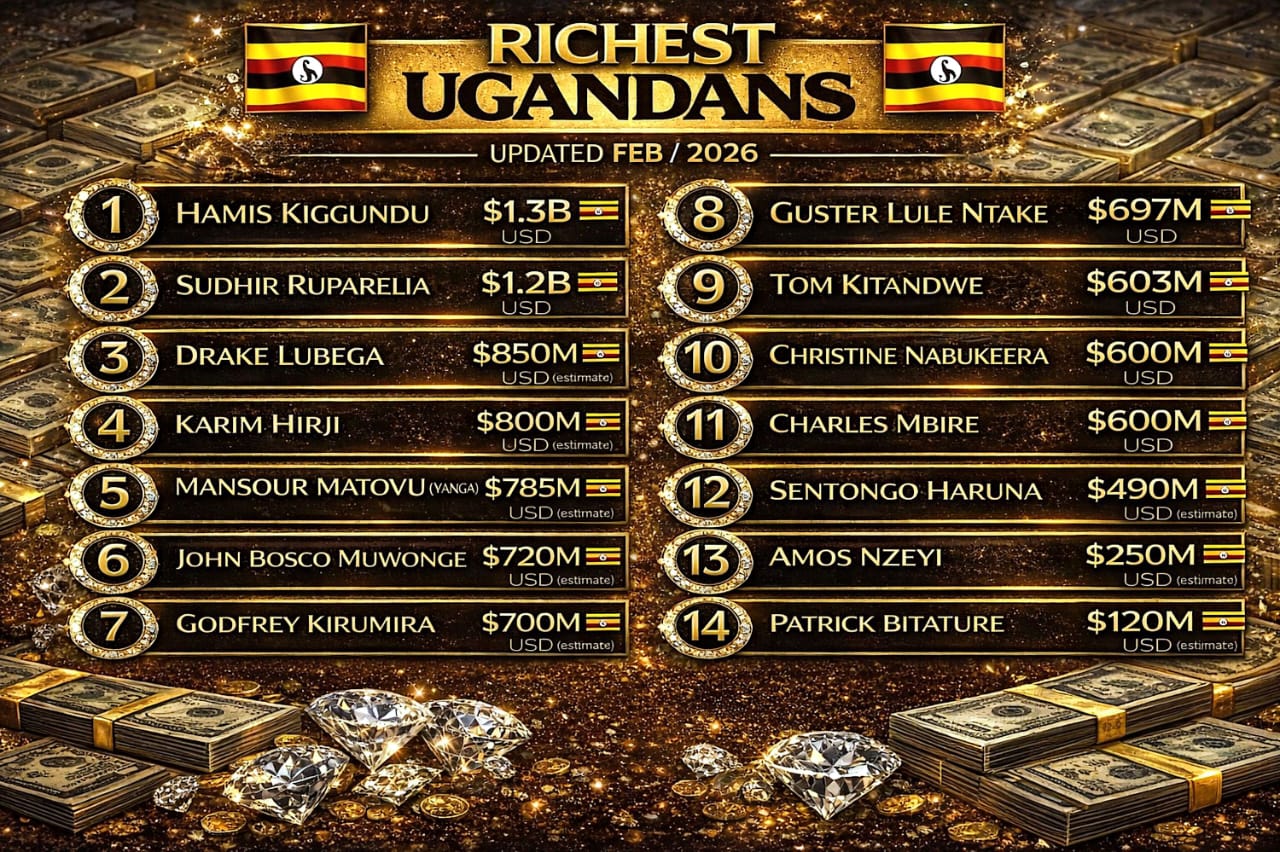
While Uganda does not publish an audited national rich list, a composite of publicly reported projects, sector presence,
corporate roles and widely circulated business estimates places fourteen individuals at the centre of the current wealth conversation.
All net worth figures referenced below are estimates derived from public reporting, business intelligence summaries and sector analysis.
They are not audited disclosures.
MACROECONOMIC CONTEXT (2023–FEB 2026)
Between 2023 and early 2026, Uganda experienced relatively moderate inflation compared to regional peers.
Uganda Bureau of Statistics (UBOS) releases through late 2025 showed annual headline inflation largely contained in low single digits, supporting price stability and predictability in long-term investment planning.
The Bank of Uganda maintained the Central Bank Rate at approximately 9.75 percent into early 2026 (Daily Monitor business coverage; The Observer monetary policy reporting).
This stable but cautious policy stance helped moderate borrowing costs while preventing inflationary pressure.
For asset-heavy investors—particularly in real estate—interest rate predictability significantly affects refinancing ability
and debt-servicing resilience.
Growth projections for FY2025/26 remained in the 6–7 percent range according to Ministry of Finance outlook briefings,
with infrastructure expansion and oil-sector developments expected to strengthen medium-term growth.
Such macro stability tends to reinforce asset valuations in urban real estate and industrial production.
PROPERTY AS A WEALTH ENGINE
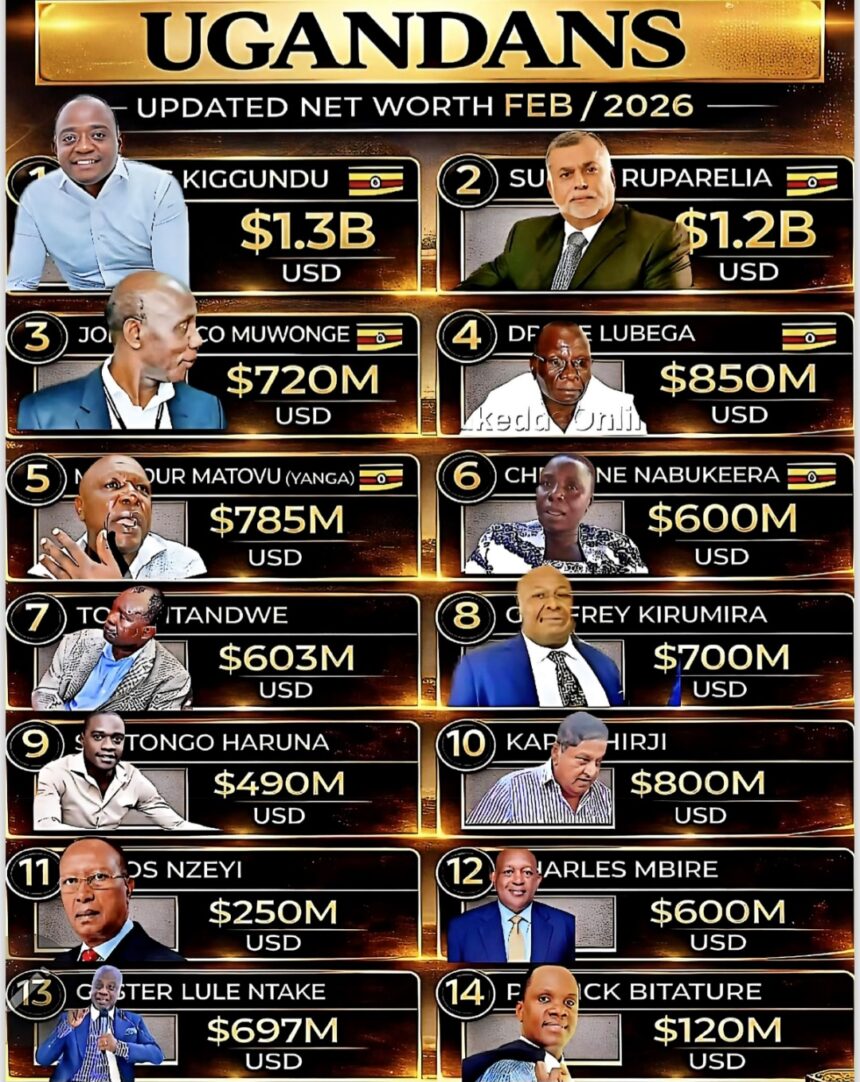
1. Hamis Kiggundu – Estimated $1.3B
Hamis Kiggundu leads the February 2026 configuration, widely estimated at approximately $1.3 billion based on composite wealth listings and property footprint analysis. His rise is closely associated with large-scale development activity, including the Nakivubo War Memorial redevelopment project, which received extensive coverage in national media as a public-private urban transformation initiative.
Analysts suggest that infrastructure-linked commercial redevelopment has materially increased property valuations in the surrounding corridors.
Strategic alignment between private capital and public infrastructure often accelerates land appreciation, which partly explains the repositioning observed in 2026.
2. Sudhir Ruparelia – Estimated $1.2B
Sudhir Ruparelia remains a central figure in Uganda’s diversified conglomerate landscape.
The Ruparelia Group spans hospitality, education, insurance and commercial property.
Continuous construction and refurbishment across Ntinda, Kololo and Nakasero have sustained asset visibility.
Diversification across multiple sectors has historically insulated his portfolio from cyclical shocks in any one industry.
3. Drake Lubega – Estimated $850M
Drake Lubega’s position is closely tied to commercial property ownership within Kampala’s central business district.
CBD rental resilience and long-standing building control support his estimated standing.
4. Karim Hirji – Estimated $800M
Karim Hirji’s Imperial Group operates major hospitality assets.
Hospitality sector recovery—supported by regional conference tourism and business travel—has contributed to valuation resilience.
However, net worth remains estimate-based due to limited public financial disclosure.
5. Mansour Matovu (Yanga) – Estimated $785M
Mansour Matovu’s commercial building footprint within Kampala has been widely profiled in business media.
Prime corridor positioning remains a decisive factor in sustained rental yield stability.
6. John Bosco Muwonge – Estimated $720M
John Bosco Muwonge has gained attention in business circles following reported acquisition activity, including references in business reporting to significant commercial property purchases such as Mukwano Arcade.
While transaction values have not been independently audited publicly, expanding central Kampala presence has reinforced his estimated positioning.
7. Godfrey Kirumira – Estimated $700M
Godfrey Kirumira’s wealth structure combines petroleum distribution with real estate investment.
Petroleum retail offers recurring demand stability, and diversified revenue streams strengthen cash-flow resilience.
Business networks such as the Kwagalana Group have further amplified his visibility.
8. Guster Lule Ntake – Estimated $697M
Guster Lule Ntake represents industrial wealth rather than purely property-led accumulation.
Manufacturing growth through food processing and related sectors supports incremental but steady capital expansion.
9. Tom Kitandwe – Estimated $603M
Tom Kitandwe’s estimated wealth is associated with substantial land holdings and construction activities.
Infrastructure adjacency—particularly around Nakivubo Channel—has been referenced in media reporting.
Such positioning can significantly reprice surrounding land values.
10. Christine Nabukeera – Estimated $600M
Christine Nabukeera is identified in business reporting as part of a significant commercial property cluster.
Urban rental stability supports valuation assumptions.
11. Charles Mbire – Estimated $600M
Charles Mbire’s wealth differs structurally due to listed equity exposure.
Board involvement with MTN Uganda provides dividend-backed liquidity.
MTN Uganda’s annual reports confirm substantial shareholder payouts in recent cycles, reinforcing stability compared to purely private rental portfolios.
12. Sentongo Haruna – Estimated $490M
Sentongo Haruna’s portfolio includes retail markets and commercial developments across Kisenyi, Nakasero, Arua Park and other suburbs.
Observers highlight ongoing construction activity and continued land acquisition in central districts.
Market-based commercial hubs generate consistent rental ecosystems, supporting recurring revenue streams.
13. Amos Nzeyi – Estimated $250M
Founder of Crown Beverages Limited, Nzeyi’s industrial footprint ties into consumer goods production.
Manufacturing margins are influenced by input costs and distribution efficiency.
14. Patrick Bitature – Estimated $120M
Patrick Bitature’s diversified Simba Group interests span hospitality, ICT and energy.
While sector diversification offers resilience, property-dominant expansion by competitors may influence relative ranking shifts.
WHY SOME MOVED AND OTHERS SHIFTED
The February 2026 repositioning appears linked to:
• Infrastructure-aligned property appreciation (e.g., Nakivubo redevelopment).
• Continuous reinvestment and visible construction activity in prime districts.
• Strategic acquisitions expanding central business district presence.
• Dividend-backed liquidity from listed equity exposure.
• Industrial scaling and petroleum cash-flow resilience.
• Monetary policy stability enabling refinancing predictability.
Conversely, individuals perceived to have slowed expansion, remained concentrated in single sectors without diversification,
or failed to capitalize on infrastructure-linked growth may have slipped down informal wealth discussions.
CONCLUSION
Uganda’s 2026 wealth landscape reflects structural alignment with macroeconomic stability,urban densification and diversified capital deployment.
All figures remain analytical estimates based on publicly available information,
UBOS economic data, Bank of Uganda policy reporting and business media coverage.
This configuration should be understood as a structural economic snapshot rather than an audited financial ledger.
Sources referenced include: Uganda Bureau of Statistics (CPI releases 2024–2025), Bank of Uganda monetary policy statements, Daily Monitor business coverage, The Observer economic reporting, MTN Uganda annual reports and public corporate disclosures.
Disclaimer: Net worth figures are estimates based on publicly available reporting and sector analysis. This document does not represent audited financial statements.
Do you have a story in your community or an opinion to share with us: Email us at Submit an Article