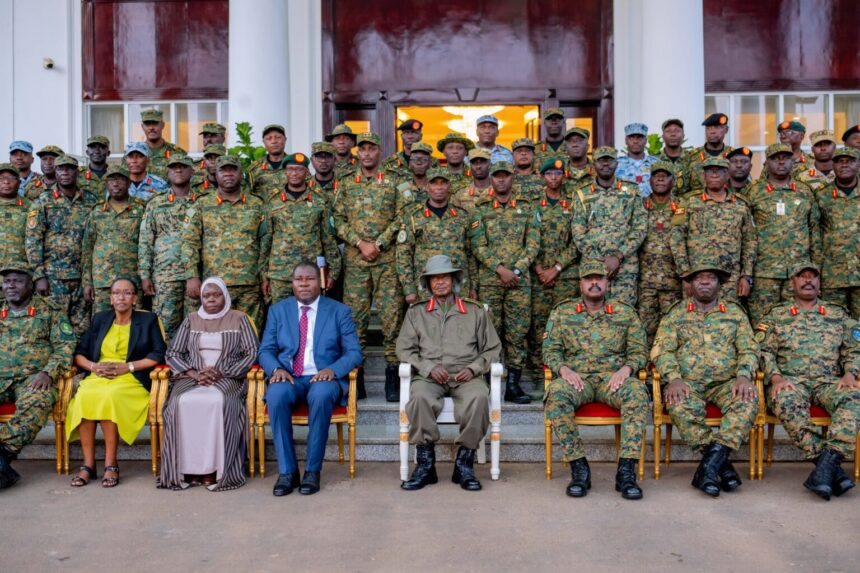
State House Entebbe – President Yoweri Kaguta Museveni, who doubles as Commander-in-Chief of the Uganda People’s Defence Forces (UPDF), on Monday chaired a high-level meeting of the UPDF High Command at State House Entebbe. The session, the first since the recently concluded 2026 general elections, focused on reviewing the country’s domestic security situation and evaluating Uganda’s broader strategic priorities both at home and in the region.
Top military brass in attendance included Chief of Defence Forces Gen. Muhoozi Kainerugaba, Deputy Chief of Defence Forces Lt. Gen. Sam Okiding, Commander of Land Forces Lt. Gen. Kayanja Muhanga, Commander of the Reserve Force Lt. Gen. Otema Awany, Commander of the Air Force Lt. Gen. Charles Okidi, and Commander of the Special Forces Command Maj. Gen. David Mugisha. Other service commanders were also present. Civilian representatives from the Ministry of Defence and Veteran Affairs joined the deliberations: Defence Minister Jacob Oboth-Oboth, State Minister for Defence Huda Oleru, and Permanent Secretary Rosette Byengoma.
In an official statement issued after the closed-door session, President Museveni commended the UPDF leadership and rank-and-file for their “discipline, professionalism, and unwavering commitment to safeguarding Uganda’s peace and sovereignty.” He declared, “Our stability is built on vigilance, unity, and patriotism,” while pledging sustained government investment to strengthen the defence sector. The President emphasised that enhanced military capacity must complement the country’s drive toward social and economic transformation.
The meeting comes against the backdrop of Uganda’s 2026 polls, which observers have hailed as the most peaceful in the nation’s electoral history. During Tarehe Sita celebrations earlier this month, Gen. Muhoozi publicly praised security forces for ensuring a calm voting environment and thanked ordinary Ugandans for cooperating with law enforcement agencies.
Beyond domestic matters, the High Command reviewed UPDF’s ongoing external operations. Uganda’s troops remain actively deployed in stabilisation missions across the Democratic Republic of Congo, South Sudan, the Central African Republic, and Somalia. These engagements, the meeting noted, reflect Uganda’s growing strategic footprint in the Great Lakes and Horn of Africa regions amid complex security challenges.
Sources familiar with the discussions described the session as a routine but critical stock-taking exercise aimed at aligning military posture with national priorities in a post-election environment. No major policy announcements or personnel changes were disclosed publicly.
For a government that has long positioned the UPDF as the bedrock of national stability, Monday’s gathering reinforces the military’s central role in both internal order and regional influence. As the new administration settles in, Watchdog Uganda will keep a close eye on how these security reviews translate into tangible improvements in civil-military relations, defence spending accountability, and respect for constitutional oversight.
The development arrives at a time when questions about military influence in politics remain part of public discourse. Transparency in such high-level security deliberations remains essential for public trust.
Do you have a story in your community or an opinion to share with us: Email us at Submit an Article