Lyantonde, Uganda | In the green, gently rolling countryside of Lyantonde District, a former security heavyweight is rewriting his own story—this time far from uniforms, sirens and command rooms. Retired General Edward Kale Kayihura, once Uganda’s longest-serving Inspector General of Police, has found a new mission in agriculture, turning personal setback into a thriving business enterprise that is steadily making its mark on the dairy sector.
The name of his venture—Katebe Business Farm—is telling. In military slang, katebe, a Luganda word meaning a stool or bench, refers to being sidelined from active duty without formal punishment. Kayihura embraced the term with humour, choosing to name his farm after it, a subtle jab at his removal from office in 2018. What might have been a bitter episode has instead become a symbol of reinvention.
Kayihura’s fall from power was dramatic. In March 2018, he was relieved of his duties as IGP by President Yoweri Museveni, arrested shortly after, and charged before the General Court Martial on several counts, including failure to account for firearms. After years in legal limbo, he was cleared in August 2023. A month earlier, he had officially retired from the Uganda People’s Defence Force, later declaring himself “free at last” from his farm in Kasagama Sub-county.
At 70, Kayihura shows little interest in dwelling on the past. Instead, he has poured his energy into agro-industrialisation, echoing the National Resistance Movement government’s long-standing push for value addition and commercial farming.
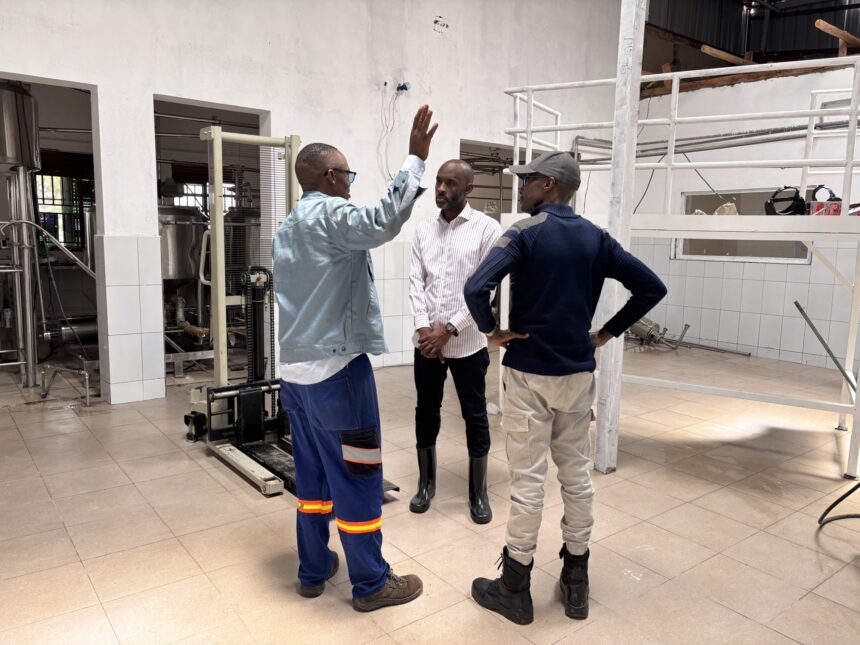
The farm recently drew high-profile political attention. Kabula County MP Asiimwe K. Enos visited the facility and later shared his impressions publicly, describing the milk plant’s progress as a clear manifestation of the NRM’s commitment to agro-industrialisation. In his message, he thanked President Museveni and Minister Monica Musenero for their role in advancing industrial value chains.
His remarks underscore the broader political significance of the project. To supporters of the ruling party, Katebe Farm represents a working example of policy translated into practice—where rhetoric about value addition is matched by visible infrastructure, modern dairy equipment and growing production capacity.
Spread across more than 350 acres, Katebe Farm is a diversified operation. It hosts expansive banana and gonja plantations, beekeeping units, horticultural projects, goat rearing, and a sizeable herd of Ankole and Friesian cattle. But the centrepiece is its modern milk processing plant—a facility that has quietly become a stabilising force for farmers in Uganda’s cattle corridor.
By offering a consistent and reliable market, the plant helps cushion farmers against price fluctuations and cuts down losses caused by delayed or failed sales. From this facility come finished products such as Katebe Yogurt and gonja crisps, which are now increasingly visible on supermarket shelves in Kampala and other major towns. The farm also produces banana flour and alkaline water, further underscoring its focus on practical value addition rather than raw produce sales.
The project has not gone unnoticed. In September 2024, Kayihura hosted officials from the Private Sector Foundation Uganda in discussions aimed at exploring partnerships to strengthen private-sector competitiveness. Earlier, a visiting Member of Parliament toured the farm and publicly praised it as a living example of how agro-industrialisation can work when backed by discipline and long-term planning.
Even within military-linked financial circles, the farm has drawn admiration. The Wazalendo Savings and Credit Cooperative Society, where Kayihura once served as founding board chairman, has cited Katebe Farm as a model of responsible investment. Its leadership has previously commended how loans were put to productive use, creating jobs and stimulating the local economy.
For residents around Katebe village, the impact is tangible. The farm employs locals, supports outgrowers, and injects cash into an area that once relied largely on subsistence farming. For younger Ugandans, particularly those facing unemployment, it offers a quiet but powerful lesson: that farming, when treated as a business, can still be a viable and respectable path.
Kayihura’s journey is less about political comeback and more about adaptation. Without public complaints or bitterness, he has turned enforced idleness into purposeful action. In a country wrestling with food security concerns and a growing youth population in search of work, Katebe Farm stands as proof that “katebe” does not have to mean wasted time.
As the retired general himself once reflected, the land he bought back in 1992 lay unused for decades—not because it lacked potential, but because his hands were too full elsewhere. Today, with time finally on his side, that dormant land is feeding people, employing communities, and quietly reshaping Uganda’s dairy value chain.
Do you have a story in your community or an opinion to share with us: Email us at Submit an Article