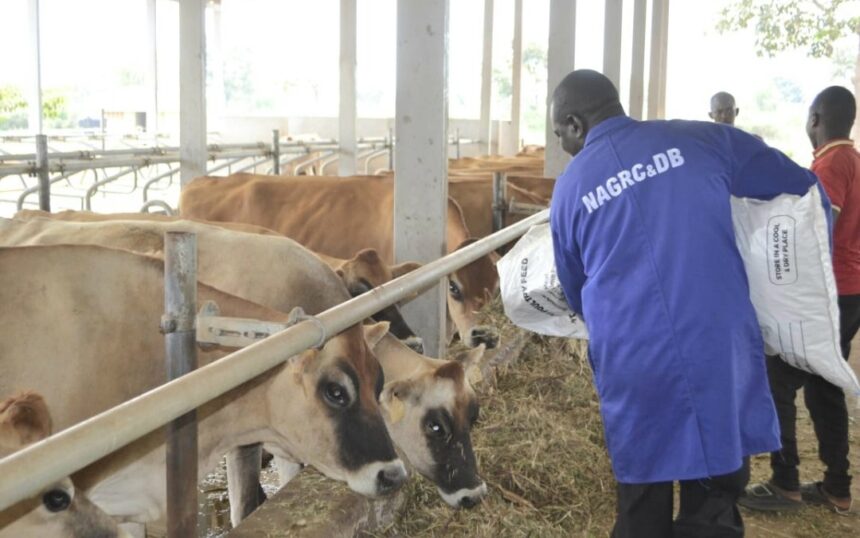
When the National Animal Genetic Resources Centre and Data Bank (NAGRC & DB) shared a short video clip on X (formerly Twitter) showing rows of high-breed dairy cattle, modern semen storage facilities, and Ugandan farmers receiving improved livestock, the post quickly drew attention. “Food security begins with genetics,” read the caption. For many Ugandans scrolling past, it was just another government update. But behind that post lies a story central to Uganda’s economy, food security, and rural livelihoods.
NAGRC & DB, a semi-autonomous agency under the Ministry of Agriculture, Animal Industry and Fisheries (MAAIF), is one of the country’s most strategic yet least understood institutions. Its mandate—conserving, improving, and commercializing animal genetic resources—touches millions of households that depend on livestock for income, nutrition, and resilience.
Livestock: Uganda’s Sleeping Giant
Livestock contributes an estimated 17 percent to Uganda’s agricultural GDP and supports more than 70 percent of rural households. Yet productivity has long been constrained by poor breeds, disease vulnerability, and climate stress.
This is where NAGRC & DB comes in.
Through its farms in Nshaara (Kiruhura), Lusenke (Nakasongola), Bulindi (Hoima), Ruhengyere (Mbarara), and other strategic locations, the agency breeds and supplies improved cattle, goats, sheep, pigs, and poultry suited to Uganda’s diverse agro-ecological zones.
Recent social media posts by the agency highlighted the distribution of improved Boran and Ankole crossbreeds to farmers, as well as advances in artificial insemination and embryo transfer technologies—tools that dramatically increase productivity without expanding land use.
From Nshaara to the Nation
In one widely shared post, NAGRC & DB showcased Nshaara Ranch, home to thousands of elite cattle, describing it as “Uganda’s genetic bank for future food security.” The message resonated at a time when climate change, drought, and rising food prices are threatening traditional farming systems.
Farmers featured in the clip spoke of higher milk yields, faster growth rates, and better market prices after switching to improved breeds. For a smallholder farmer, this can mean the difference between subsistence and surplus.
Science Meets Survival
Beyond visible farms, NAGRC & DB plays a critical scientific role. The “data bank” aspect of its name refers to the preservation of animal genetic material—semen, embryos, and DNA—safeguarding indigenous breeds from extinction.
This work rarely trends online, yet it is essential. Indigenous breeds like the Ankole long-horned cattle are uniquely adapted to local conditions, resistant to disease and harsh climates. Losing them would mean losing generations of natural adaptation.
A recent post by a senior agriculture official praised NAGRC & DB for “protecting Uganda’s genetic heritage while modernizing livestock production,” sparking renewed public interest in the agency’s dual role of conservation and commercialization.
Jobs, Youth, and the Parish Economy
NAGRC & DB has also increasingly positioned itself within national development frameworks such as the Parish Development Model (PDM). Improved livestock is being promoted as a fast-track income source for rural households, especially youth and women.
Social media images of young graduates working as farm managers, veterinary technicians, and data officers at NAGRC farms challenge the narrative that agriculture is outdated or unprofitable.
For a country where youth unemployment remains a pressing issue, livestock value chains—powered by better genetics—offer real opportunity.
Public Interest Grows
The recent wave of online engagement around NAGRC & DB suggests a growing public appetite for stories about production, not just politics. In a digital space often dominated by controversy, posts showing milk yields, breeding programs, and farmer success stories stand out.
They also raise questions: Is enough funding going into livestock genetics? Are smallholders accessing these resources equitably? How can technology scale beyond pilot farms?
More Than a Government Agency
NAGRC & DB may not trend daily, but its impact is deeply woven into Uganda’s future. As climate pressures intensify and food systems are tested, the quiet work of preserving and improving animal genetics becomes headline-worthy.
That viral clip on X was more than content—it was a glimpse into how Uganda feeds itself, earns livelihoods, and prepares for the future.
And for once, the story of transformation didn’t start in Parliament or State House—but on a farm.
Do you have a story in your community or an opinion to share with us: Email us at Submit an Article