
Kampala, Uganda — In the heart of Greater Masaka, a new name is steadily gaining traction — not from the usual corridors of power, but from football pitches, coffee gardens, and village mobilisation drives.
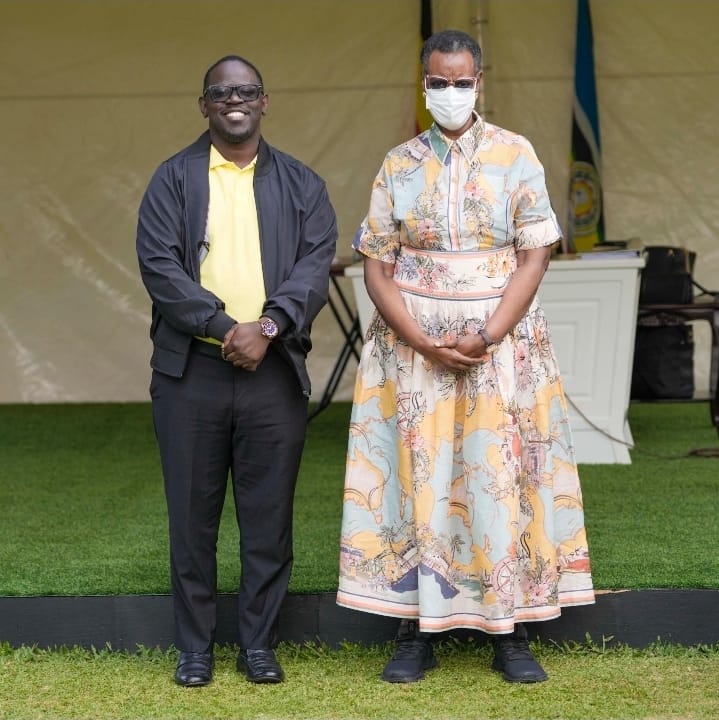
Oscar Mutebi, grandson to former Vice President Edward Kiwanuka Ssekandi, is carving out his own identity as a grassroots mobiliser and emerging development force in rural Masaka District.
Locally branded “Owebyenkulakulana” — loosely translated as the development champion — Mutebi is positioning himself at the intersection of youth empowerment, agriculture, and community-driven initiatives in one of Uganda’s largely under-exploited regions.
From Family Legacy to Grassroots Action
While his lineage links him to one of Uganda’s most seasoned political figures, Mutebi is building a reputation that leans more on visibility in communities than pedigree.
Currently serving as a Personal Assistant within circles linked to Ssekandi, Mutebi has increasingly turned his attention to rural transformation — particularly in Kyanamukaka Town Council, his home area.
His approach is practical and visible: distributing coffee seedlings to farmers, supporting youth sports, and extending basic equipment to schools and health centres.
At St. Mugaga Secondary School, local leaders say his contributions — ranging from scholastic materials to sports kits and a flat-screen television — have elevated both morale and participation in co-curricular activities.
Football, Coffee and Community Mobilisation
Mutebi’s model blends soft power with economic messaging.
Through annual tournaments such as the now popular “Oscar Cup” in Kyanamukaka, he is using sports as an entry point to engage young people, identify talent, and build community cohesion.
One such tournament held earlier this month in Kamunzinda drew thousands, with local teams battling it out for trophies, medals, and cash prizes — a rare spectacle in a rural setting where organised sports often struggle for funding.
But beyond football, coffee remains at the centre of his development pitch.
Working alongside government-backed programmes, Mutebi has been instrumental in distributing seedlings to farmers across Masaka, Kyotera, Kalungu, Mpigi and Lyantonde — aligning himself with broader national strategies on household income improvement.
Riding on the NRM Mobilisation Wave
Politically, Mutebi has not shied away from aligning with the ruling National Resistance Movement.
During the 2026 general elections cycle, he was actively involved in mobilisation efforts for Yoweri Kaguta Museveni across the Greater Masaka sub-region — an area traditionally seen as politically competitive.
Allies credit him with energising youth participation and grassroots engagement, though critics argue such mobilisation often blurs the line between development work and political capital-building.
The Bigger Pitch: A Vocational Institute
Beyond short-term interventions, Mutebi and his backers are pushing for a more structural legacy — the establishment of a vocational training institute in rural Masaka.
The argument is straightforward: with a youthful population, high school dropout rates, and heavy reliance on subsistence farming, the region needs technical skills hubs to unlock employment opportunities.
Backed by voices including Ssekandi himself, the proposal is being directed toward the Ministry of Education and Sports under Janet Kataha Museveni.
The vision includes:
- Skills training in mechanics, carpentry, and ICT
- Support for agro-processing and value addition
- Attraction of small-scale industries and investors
With vast tracts of land reportedly available, proponents argue the project could transform rural Masaka into a regional skills and production hub.
Untapped Potential, Growing Expectations
Statistics paint both a challenge and an opportunity.
Masaka District’s population — estimated at nearly 300,000 — is largely youthful, with over 80% dependent on subsistence farming. Access to formal employment remains limited, making interventions like vocational training increasingly urgent.
The region’s fertile soils, bimodal rainfall, and proximity to Lake Victoria offer strong agricultural potential — but value addition and industrialisation remain minimal.
Between Promise and Proof
For now, Oscar Mutebi’s rise reflects a broader trend in Uganda’s politics and development space — the emergence of young, locally rooted actors leveraging both social capital and state-linked networks to build influence.
Supporters see him as a results-oriented mobiliser filling gaps left by formal systems.
Skeptics, however, caution that sustained impact will depend on moving beyond donations and events to long-term, institutional change.
Mutebi himself insists his mission is simple: service.
“I started from home,” he recently said during a community event. “Development begins with giving back.”
Whether that vision translates into lasting transformation for rural Masaka remains to be seen — but one thing is clear: the ground is shifting, and new actors are stepping into the arena.
Do you have a story in your community or an opinion to share with us: Email us at Submit an Article