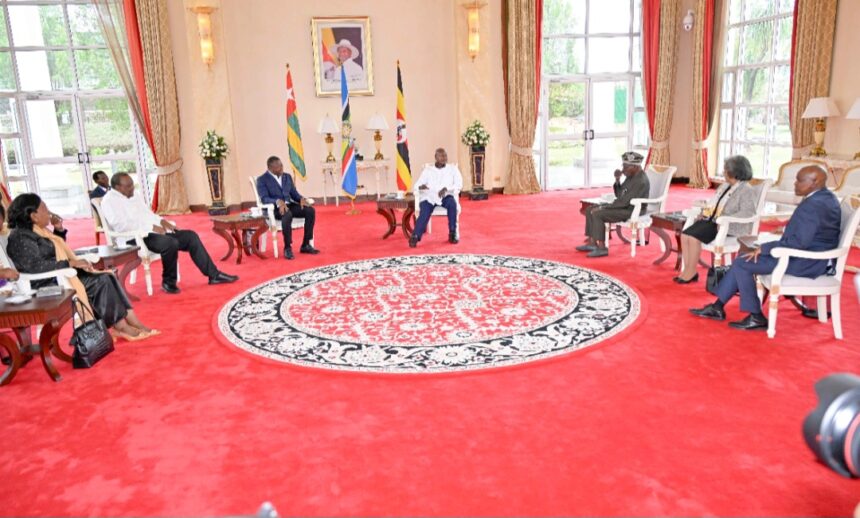
President Yoweri Kaguta Museveni has today hosted leaders of the AU–EAC–SADC panel of facilitators of the Democratic Republic of Congo (DRC) Peace Process at State House, Entebbe.
The meeting was part of the ongoing efforts to advance dialogue and stability in Eastern DRC.
The high-level panel of facilitators, which is on a working visit to Uganda, was chaired by H.E. Faure Essozimna Gnassingbé, President of the Republic of Togo, and brings together former African heads of state mandated to support regional dialogue and strengthen collective efforts toward sustainable peace and stability in Eastern DRC.
The panel included H. E. Olusegun Obasanjo (former President of Nigeria), H.E. Uhuru Kenyatta (former President of Kenya), H.E. Sahle-Work Zewde (former President of Ethiopia), H.E. Dr. Mokgweetsi Eric Keabetswe Masisi (former President of Botswana), and H.E. Catherine Samba-Panza (former President of the Central African Republic).
During the meeting, President Museveni said the conflict in the DRC is well understood within the region and should not be allowed to persist, given its long-standing humanitarian and historical impact on neighbouring countries.
“This problem is very well known to us. We currently have more than 500,000 Congolese refugees in Uganda. They are part of nearly two million refugees we host from the region.”
He noted that many of the refugees come from neighbouring countries and share ethnic and cultural ties with communities in Uganda, particularly in western and South-Western parts of the country.
“Many of these people are members of our own tribes, Those from Congo are the same as those in western and south-Western Uganda. We know this problem very well,” he said.
President Museveni also expressed concern that despite the long history of the conflict and its clearly identifiable grievances, progress toward a lasting solution has been slow.
“It is a shame that it is taking so long to solve,” he said.
Placing the crisis in its historical context, the President recalled earlier international debates over Congo’s future, noting that the nature of the conflict has evolved over time.
“In the past, there were even discussions about breaking up Congo, the Katanga Secession and all that but luckily today, nobody is talking about breaking up Congo. What we are dealing with now are grievances,” he highlighted.
He said such grievances can be addressed through sustained dialogue and a clear understanding of the realities on the ground.
President Museveni further welcomed the visiting panel, led by President Gnassingbé, and thanked its members for engaging on an issue that continues to affect the entire Great Lakes region.
“I thank His Excellency, the President of Togo, for coming with this delegation. We are very happy to welcome you here,” the President said.
On his part, President Gnassingbé thanked President Museveni for hosting the delegation and commended Uganda’s continued commitment to regional peace and stability.
“On behalf of the delegation, I would like to sincerely thank Your Excellency for the warm reception accorded to us,” President Gnassingbé said.
He acknowledged President Museveni’s longstanding role in regional mediation efforts, noting that the panel values his experience and guidance in addressing complex conflicts on the continent.
On the other hand , H.E Obasanjo emphasised that sustainable peace in Eastern DRC requires solutions that are rooted in Africa’s realities, warning against overreliance on externally driven approaches.
“This crisis is not only about the M23. There are many grievances that have not been adequately addressed. Solutions imported from Washington, Doha, Paris, or elsewhere may be helpful, but they cannot by themselves provide a complete or lasting solution.”
He said the panel had deliberately taken responsibility to pursue African-led responses to African challenges, while remaining open to constructive support from international partners.
“As facilitators, we have taken it upon ourselves to find African solutions to African problems.We see President Museveni as uniquely positioned, and we are walking with him to see how these African solutions can be realised,” H.E Obasanjo said.
He added that the involvement of partners outside the continent should be complementary, not dominant.
“We are not pushing away those who have shown interest whether from Washington, Qatar, France, or elsewhere because they are helpful in the process we are trying to advance,” he said.
He also thanked President Museveni for receiving the delegation at short notice and underscored the importance of correctly diagnosing the root causes of the DRC conflict.
“The issue that has brought us together is one we are all familiar with. It is the challenge of managing or mismanaging diversity within the DRC, and the relationship between the DRC and its neighbours,” he said.
“In order to solve the problem, we must diagnose it properly and administer the right medicine.”
H.E Obasanjo welcomed the African Union’s leadership in the peace process, including the establishment of a joint headquarters in Addis Ababa, and reiterated the need for Africa to take ownership of its peace and security agenda.
“We have taken it upon ourselves to find African solutions to African problems,” he noted.
The high level meeting was also attended by Uganda’s government officials including; Ministers, Ambassador and Permanent Representative of Uganda to the United Nations, Adonia Ayebare and former Prime Minister, Rt. Hon. Amama Mbabazi.
Do you have a story in your community or an opinion to share with us: Email us at Submit an Article