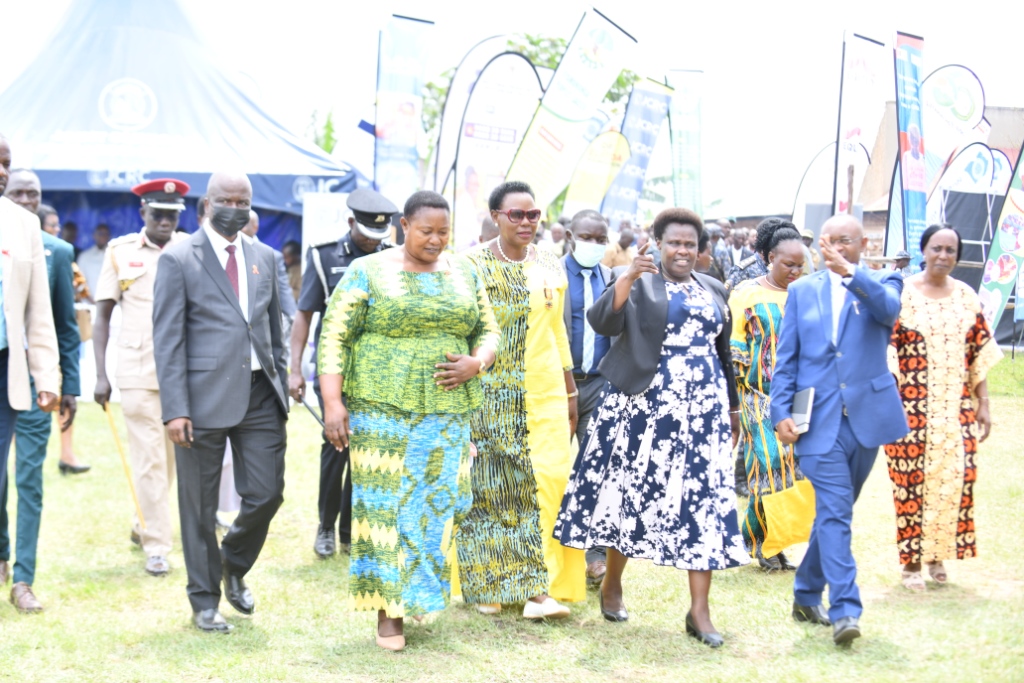
The Minister for the Presidency, Hon. Babirye Milly Babalanda, has informed Ugandans that the Government of Uganda is committed to supporting the HIV financing to reduce the donor dependency to build a sustainable HIV response to end HIV/AIDS as a public health threat by 2030.
“With government effort, we need to develop resilience and support the HIV interventions in our society. We need to maximise the opportunities in all government programmes, build synergy and create impact in all areas to end AIDS by 2030. Let us utilise the government structures to ensure services reach the entire population. HIV mainstreaming agenda, additional government budget to fill the gap. At the national level, the Government of Uganda has prioritised interventions that would help to reduce stigma, provide services and create empowerment and opportunities for livelihood programmes in the Ministry of Gender, Labour and Social Development, the Ministry of Agriculture, Animal Industry and Fisheries, and the Parish Development Model for the vulnerable persons, including people living with HIV. The Ministry of Health provides the services across the country.”
“All sectors ensure HIV, TB and health-related conditions such as non-communicable diseases are integrated into all the development plans and reported. The ARVs and other services will be integrated into the primary health care delivery model of the Ministry of Health. Drugs will be available in all the facilities, and nobody should be denied services.”
The minister made her remarks today, 1st December, during the commemoration of World AIDS Day at Kazinda grounds, Bushenyi District, which was presided over by Her Excellency the Vice President, Rtd Maj. Jessica Alupo, representing Rtd Gen. Yoweri Kaguta Museveni, the President of the Republic of Uganda, under the international theme for World AIDS Day, “Overcoming disruption, transforming the AIDS response”, which has been customised nationally as “Building a sustainable HIV response to end AIDS as a public health threat by 2030”, as a clear testament that there is a need for everyone to take responsibility to support and take action to end AIDS by 2030.
“As a country, we are proud of the NRM Government leadership and strategic direction provided to end AIDS as a Public health threat by 2030. Great Progress has been made, as you have seen,, for the 7th Edition of the Presidential Fast Track Objectives presented by UAC.”
Minister Babalanda hailed the leadership of the Uganda AIDS Commission for emulating the idea of ensuring that commemorating the National Functions rotates in regions every year.
“It is about building linkages in ensuring that the messages are shared in the different regions to enable participation and involvement in the goal of ending AIDS by 2030 as a public health problem. “World AIDS Day was in the East last year, and here we are now in the West” she said
“Your Excellency, we are here joining the World today to commemorate World AIDS Day, which is one of the largest grassroots mobilisation campaigns for HIV awareness in the World. The first World AIDS Day was in 1988, intended to provide a platform to raise awareness about HIV and AIDS and honour the lives affected by the epidemic, and it has been taking place annually every 1st of December since then. This provides an opportunity for communities to stand in solidarity with those who lost their dear ones to AIDS and a platform for advocacy and stimulation of individual and collective resolve into actions to fight the epidemic.”
The minister highlighted the history of HIV to the young generation in Uganda.
“The first case of AIDS was described in Rakai District, and it was commonly known as “silimu”. This disease was not recognised as AIDS until 1985 when prominent Ugandan medical scientists made the first diagnosis. At that time, our beloved H.E. the President of Uganda Rtd. Gen. Yoweri Kaguta Museveni mobilised the whole country to respond to the HIV scourge. We thank you, Your Excellency,, for your visionary leadership. We know that the HIV pandemic has caused untold suffering among Ugandans. It is a deadly disease even to date and remains very expensive to manage; we don’t have a cure, and many people have lost their lives. Indeed, it was a security threat in the country.”
“I therefore thank all the stakeholders who heeded the call by H.E. the President under the Multi-Sectoral Approach to galvanise and support the HIV response in the country.”
The minister also noted the significant progress in reducing the HIV prevalence in the country from over 18% in the 1990s to around 4.9% to date.
“This success has been largely attributed to the high-level political commitment spearheaded by you, Your Excellency and the multi-sectoral approach to managing the epidemic at the National and subnational levels. However, we still a big about 4 people getting infected per day”.
“H.E. The President launched the Presidential Fast Track Objectives for Ending AIDS by 2030 in Uganda as a public health threat in 2017 and I am happy to see great progress in the implementation of all 5 pillars.”
The Minister commended H.E. President Museveni and the government for filling the gap to making sure that our 1.5 million people living with HIV do not miss services in the country, despite the recent policy changes on donor assistance.
“This reminds all citizens that the NRM Government will continue to fulfil its obligations.”
“At Macro level, the Government has also positioned HIV as a cross-cutting issue and mainstreamed it in the National Development Plan IV; which will ensure that HIV is mainstreamed and services reach the entire population, ” she said
The minister also reminded Ugandans that HIV remains a public health threat and a very expensive disease to treat and reiterated the government’s commitment to ending AIDS as a public health threat in Uganda by 2030.
“Therefore, the Government of Uganda assures all our people living with HIV that ARVs and services will be provided to all people living with HIV in Uganda.”
The minister encouraged Religious and Cultural leaders to support the government in reaching the communities with the HIV message dissemination across the country.
“The ARVs and other services will be integrated into the primary health care delivery model by the Ministry of Health. Drugs will be available in all the facilities, and nobody should be denied services.”
“UAC should monitor the implementation of the National HIV Strategic Plan and follow up on the HIV intervention for accurate reporting in all sectors and non-state actors.”
The minister called for a collective responsibility in mobilising communities and creating awareness till the goal of ending AIDS by 2030 as a public health threat in Uganda and sustaining interventions beyond 2030 in Uganda is achieved.
The minister rallied support for President Museveni in the forthcoming general election.
“To the people living with HIV/AIDs, I call upon you to vote for NRM because the positive living that people are experiencing is one of the gains of the NRM government”.
The event was attended by several dignitaries, CEC Members, Al-Hajji Dr Hassan Basajjabalaba, Chairperson Women’s League, Hon. Adrine Kobusingye, Minister for Local Government, Hon. Raphael Magezi, Director of Uganda AIDS Commission, Dr. Nelson Musoba, Dr Ruth Senyonyi, Chairperson, UAC, leadership of NAFOPHANU, Development partners, Religious Leaders, area members of parliament, among others.
Do you have a story in your community or an opinion to share with us: Email us at Submit an Article