President Yoweri Kaguta Museveni has called on both ruling National Resistance Movement (NRM) leaders and opposition politicians to take greater responsibility in monitoring government programmes and ensuring effective service delivery, warning that leaders who fail to oversee public initiatives should be held accountable.
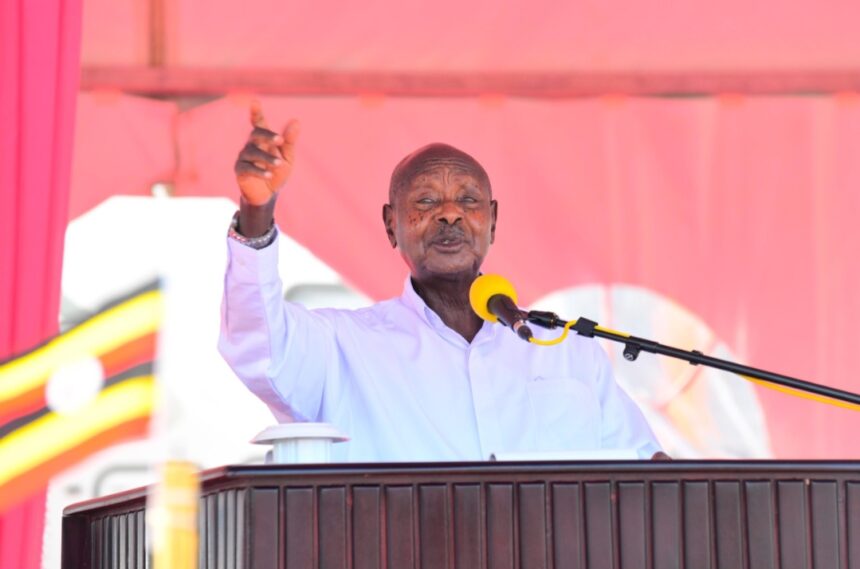
The President made the remarks today during the reading of Uganda’s Shs84.4 trillion national budget for the Financial Year 2026/27 at the Kololo Ceremonial Grounds. The budget was presented by the Minister of Finance, Planning and Economic Development, Hon. Henry Musasizi on behalf of the President and it focuses on accelerating economic growth, improving service delivery and supporting productive sectors as Uganda pursues its ambition of becoming a middle-income, high-growth economy.
President Museveni said Uganda has made significant progress economically but stressed that weaknesses in implementation and supervision continue to undermine government programmes.
“We are to demand performance from both the NRM and also the opposition. As long as you are getting money from the government, you must check what is happening on the ground,” he said.
The President argued that elected leaders, regardless of political affiliation, have a duty to monitor government projects in their constituencies and ensure public resources reach intended beneficiaries.
He cited persistent complaints about theft of funds under the Parish Development Model (PDM), saying he encountered grievances during the recent election campaigns in various parts of the country.
“People were complaining that their PDM money had been stolen. I found the same complaints in Maracha, Kween, Kampala, Kawempe and Buwambo. What are the Members of Parliament doing? What are local leaders doing?” he asked.
President Museveni warned that government officials, local leaders and legislators who neglect their monitoring responsibilities would increasingly come under scrutiny.
“I will ask the Attorney General to see how I can deal with leaders who are paid to monitor but do not do their work,” he said.
The President stressed the need to move the remaining 33 percent of Ugandans who are still outside the money economy into productive economic activity, describing this as the country’s most important development challenge despite impressive economic gains recorded over the years.
“For now, let all political leaders take the lead in getting 33 percent of our people who are outside the money economy to join the money economy,” he said.
The President traced Uganda’s economic journey from the colonial era, noting that by Independence in 1962, only about 9 percent of Ugandan households participated in the money economy while 91 percent remained in subsistence production.
According to President Museveni, progress has been gradual, with participation increasing to 32 percent by 2013 before rising to the current 67 percent through initiatives such as Operation Wealth Creation and the Parish Development Model.
“Although we have done well, we could have done much better. The challenge now is the 33 percent who are still outside the money economy,” he said.
President Museveni directed ministers, Members of Parliament and local government leaders to actively monitor PDM implementation parish by parish to ensure funds are not stolen and beneficiaries are supported to generate income.
“The eyes of the dead body are the eyes of the one carrying it,” he said, using a traditional proverb of the Banyankore to emphasise leadership responsibility.
Budget anchored on wealth creation:
Presenting the budget, Hon. Musasizi said the government remains committed to transforming household incomes and expanding economic participation.
He revealed that over the last five years, the government has transferred Shs4.4 trillion as revolving capital to all 10,589 parishes under the Parish Development Model.
“To date, the government has invested close to Shs11 trillion directly into wealth-creation initiatives targeting households in the subsistence economy, farmers, youth, women and businesses,” Hon. Musasizi said.
The minister described PDM as the government’s most important intervention for eliminating subsistence production and expanding participation in the money economy.
He also announced strong growth in domestic revenue mobilisation.
“In FY2026/27, domestic revenue is projected to increase to Shs45.6 trillion from Shs35.7 trillion in FY2025/26, equivalent to 15.9 percent of GDP,” Hon. Musasizi said.
The additional resources, he noted, will support wealth creation programmes, agricultural transformation initiatives and infrastructure development.
The government projects Uganda’s economy to grow by 10.2 percent next financial year, up from the current growth rate of 6.4 percent, largely driven by petroleum production and continued investment in productive sectors.
President Museveni described the current performance as impressive by global standards but maintained that the country has the potential to achieve even stronger growth.
“Uganda is a very rich country. We have enormous potential and we have only begun to tap it,” he said.
The President dismissed criticism that the government is spreading investments too broadly, arguing that Uganda possesses diverse natural resources and opportunities unlike countries that specialised in only a few sectors during their industrialisation.
He emphasized that the African market remains critical for Uganda’s future prosperity.
“When you produce, you must sell. Africa is our sure market,” he said.
Hope in oil revenues and strategic infrastructure:
President Museveni expressed optimism about the economic transformation expected from Uganda’s emerging petroleum sector. He revealed that the government expects to earn approximately $1.5 billion annually from its share of oil revenues once production commences.
Part of the revenue, he said, will be invested in a sovereign wealth fund while another portion will finance strategic infrastructure projects.
“We need to create a sovereign fund so that the money can earn more money, as countries like Norway have done,” President Museveni said.
He identified regional railway networks linking Uganda to Kenya, Tanzania, the Democratic Republic of Congo, South Sudan and Rwanda as priority investments.
According to the President, shifting heavy cargo transportation from roads to railways and pipelines will significantly reduce transport costs and enhance regional competitiveness.
President Museveni defends trade order and environmental protection:
The President also defended government efforts to remove traders from road reserves and protect wetlands from encroachment. He criticized politicians who oppose enforcement measures aimed at restoring urban order and environmental conservation.
“The road is for vehicles. The sidewalks are for pedestrians. Markets are for selling goods,” he said.
The President warned that continued destruction of wetlands threatens Uganda’s ecological balance and long-term survival.
“The swamp is for water. It is not for rice, sweet potatoes or buildings,” he said.
President Museveni blamed decades of environmental degradation on political opportunism and called for stronger enforcement of conservation laws.
The Ebola situation is improving:
Addressing the ongoing Ebola outbreak, President Museveni assured Ugandans that the situation remains under control and can be contained through vigilance and responsible behaviour. He disclosed that Uganda has recorded 19 cases so far, including 14 Congolese nationals and five Ugandans.
According to the President, two people have died while several others have recovered and been discharged. He reported that four Congolese patients and one Ugandan have already recovered, while the remaining patients are improving.
“In the last five days there has been no new case,” President Museveni said.
He explained that unlike COVID-19, Ebola spreads through direct contact with bodily fluids rather than through breathing, making it easier to contain.
The President urged Ugandans to avoid unnecessary physical contact, including handshakes and hugs, and to report symptoms early for treatment.
“Ebola is not a serious problem if people follow the guidelines. It is easy to avoid, and patients can recover if they receive treatment early,” he said.
President Museveni also revealed that Uganda and the Democratic Republic of Congo are working together to establish screening and treatment facilities near border areas to prevent cross-border transmission.
Do you have a story in your community or an opinion to share with us: Email us at Submit an Article