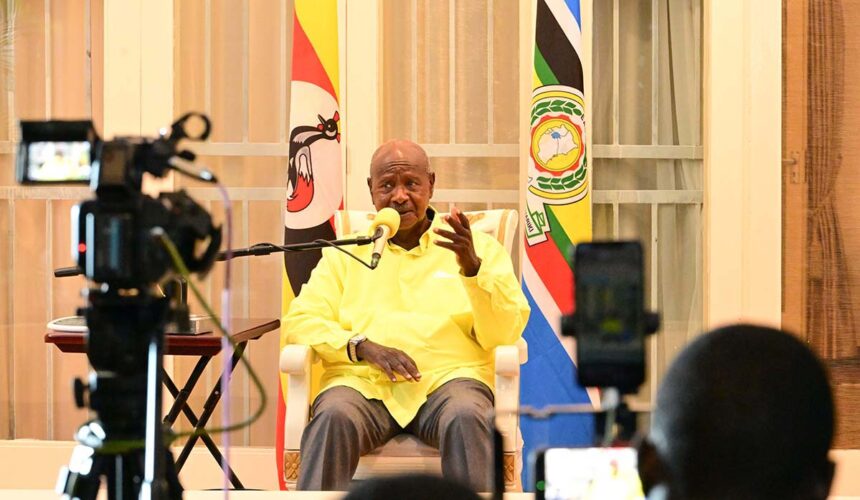
Kampala – President Yoweri Kaguta Museveni has moved to calm growing public concern over the controversial Protection of Sovereignty Bill 2026, making it clear that the proposed law is not intended to block foreign investments, diaspora remittances, church donations, or legitimate private business transactions.
In a direct message to Ugandans, especially the Bazzukulu, the President said much of the public debate surrounding the bill has been driven by misunderstanding and misinformation. He stressed that the original intention of the legislation is simple: to protect Uganda’s sovereign right to make independent national decisions without undue foreign influence.
“That is not the Bill I initiated,” Museveni stated firmly, distancing himself from interpretations suggesting the law would cripple Foreign Direct Investment (FDI), interfere with private capital transfers, or stop Ugandans abroad from sending money home.
The Real Meaning of Sovereignty
According to the President, sovereignty is about a nation having the freedom to determine its own political, economic, social, and diplomatic path without external pressure.
Uganda’s history—from colonial domination to liberation struggles—has shaped a deep understanding of the importance of self-rule. Museveni argues that sovereignty must go beyond flag independence and include policy independence: the ability of Ugandans to make decisions based on national interests, not foreign agendas.
The Protection of Sovereignty Bill, as originally discussed by Cabinet, was designed to address situations where foreign funding or influence is allegedly used to manipulate Uganda’s internal policy decisions against the country’s strategic interests.
It was never meant, he said, to interfere with legitimate business operations, investments, religious support systems, or family remittances that millions of Ugandans depend on.
Directing Parliament to Stay Focused
To prevent the bill from drifting into areas that could hurt the economy, President Museveni has already engaged Government Chief Whip Hamson Obua and leaders of relevant Parliamentary committees.
He instructed them to ensure that the legislation remains narrowly focused on protecting national policy sovereignty.
“The Bill should concentrate on the sovereignty of policy decision-making and not meander into areas of freedom of private enterprise transfers, private money transfers, or church donations,” the President directed.
This intervention comes at a critical time as Parliament continues scrutinizing the bill, which was tabled earlier this month by the State Minister for Internal Affairs.
His clarification signals that while government remains committed to defending Uganda’s independence, it is also willing to listen to concerns raised by citizens, investors, religious institutions, and the diaspora community.
Why This Matters
Uganda’s economy today relies heavily on several key pillars:
- Foreign Direct Investment that creates jobs and transfers skills
- Diaspora remittances that sustain millions of families
- Religious and charitable donations that support education, health, and social services
- Private sector capital flows that drive entrepreneurship and innovation
Any law perceived as threatening these lifelines naturally triggers anxiety.
That is why Museveni’s clarification is significant.
It reassures investors that Uganda remains open for business.
It reassures Ugandans abroad that their support to families back home remains protected.
It reassures churches, mosques, and NGOs that genuine development partnerships are not under attack.
And it reassures ordinary citizens that sovereignty does not mean economic isolation.
Sovereignty Without Isolation
The President’s message reflects a broader Pan-African principle long championed by leaders such as Julius Nyerere: true independence means having the right to make your own national choices and live with their consequences.
Protecting sovereignty is not about rejecting international cooperation.
It is about ensuring partnerships happen on Uganda’s terms, with mutual respect, and without hidden political conditions.
Museveni’s approach suggests Uganda wants strong foreign partnerships—but not foreign control.
That distinction is politically important, especially at a time when many African nations are rethinking the balance between foreign aid, international influence, and national autonomy.
A Call for Responsible Debate
As Parliament continues debating the bill, the President’s guidance offers a clear path forward: defend Uganda’s national interests without harming enterprise, investment, or family livelihoods.
This means lawmakers must draft carefully, avoiding broad clauses that could scare investors or create unnecessary legal uncertainty.
It also means citizens should engage constructively—focusing on improving the bill rather than spreading fear.
A good sovereignty law should protect the country from covert interference while preserving constitutional freedoms and economic openness.
That balance is the real test.
Uganda First
President Museveni’s clarification reinforces a long-standing principle of his leadership: Uganda must remain strong, self-reliant, and capable of making its own decisions.
For supporters, this is seen as another example of leadership focused on putting Uganda first—protecting national dignity while maintaining economic growth and stability.
For critics, the challenge will be ensuring the final law reflects those assurances in practice, not just in political speeches.
Either way, one thing is now clearer: the Protection of Sovereignty Bill is not supposed to be a war against investment or remittances—it is meant to be a shield against undue foreign influence over Uganda’s future.
And in a rapidly changing world, that debate is far from over.
Do you have a story in your community or an opinion to share with us: Email us at Submit an Article