
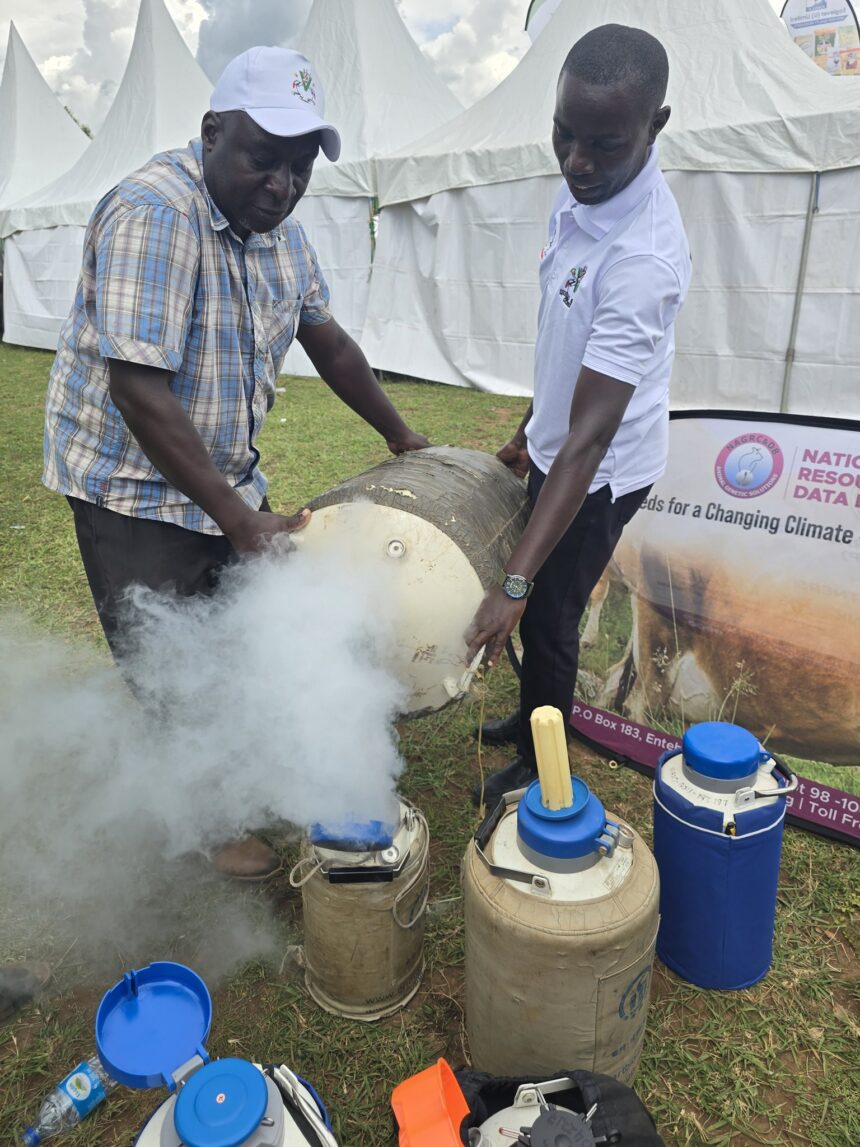
Bukedea — The National Animal Genetic Resources Centre and Data Bank (NAGRC&DB) has reinforced Uganda’s livestock modernization drive through the distribution of liquid nitrogen tanks and semen straws to Bukedea District officials and Artificial Insemination (AI) technicians as the country concluded the 2026 World Veterinary Week celebrations.
The intervention is expected to strengthen veterinary service delivery, improve breeding systems, and boost livestock productivity among farmers in the Teso sub-region and beyond.
Artificial insemination remains one of the most effective scientific methods of improving animal breeds by enabling farmers to access superior genetics without necessarily keeping expensive pedigree bulls on their farms. Through semen straws preserved in liquid nitrogen cryogenic tanks, farmers can breed stronger, more productive cattle with better milk yields, faster growth rates, and improved disease resistance.
Officials from NAGRC&DB said the distribution is part of the institution’s broader mandate to conserve, develop, and promote Uganda’s animal genetic resources while supporting government’s agenda of commercial agriculture and household income improvement.
Liquid nitrogen tanks play a critical role in the process by preserving semen at extremely low temperatures, ensuring viability until the time of insemination. Proper handling of these cryogenic tanks is essential because the stored semen must remain under controlled temperatures for successful breeding outcomes.
Veterinary officers and AI technicians in Bukedea welcomed the support, saying the equipment will significantly reduce breeding challenges faced by local farmers, especially those in remote rural communities where access to quality breeding services has remained limited.
The move also aligns with government’s wider strategy of modernizing agriculture through science, technology, and innovation under the Parish Development Model and the broader agro-industrialization agenda.
Over the years, NAGRC&DB has increasingly positioned itself at the center of Uganda’s livestock transformation through cattle breed improvement, poultry multiplication, goat breeding programs, embryo transfer technologies, and pasture development initiatives.
Recent projects such as the promotion of the high-performing Kasolwe Brown Goat breed and the rollout of Kuroiler chicken programs for youth groups have further demonstrated the agency’s commitment to making livestock farming more profitable and commercially viable.
As Uganda seeks to expand livestock exports and improve household incomes, experts say stronger veterinary systems and improved animal genetics will be critical pillars in achieving that vision.
The Bukedea distribution therefore marks more than a ceremonial handover—it signals Uganda’s steady shift from traditional subsistence livestock keeping to science-driven, market-oriented animal production.
Do you have a story in your community or an opinion to share with us: Email us at Submit an Article