The Minister for the Presidency, Hon. Babirye Milly Babalanda has implored Resident District Commissioners (RDCs) to shift their focus back to the core mission of government, which is service delivery and socio-economic transformation of Ugandans, given the fact that the election period is over.
“H. E President Yoweri Kaguta Museveni has consistently emphasized that the success of government programs depend largely on your effective monitoring and supervision at the district level,” she said.
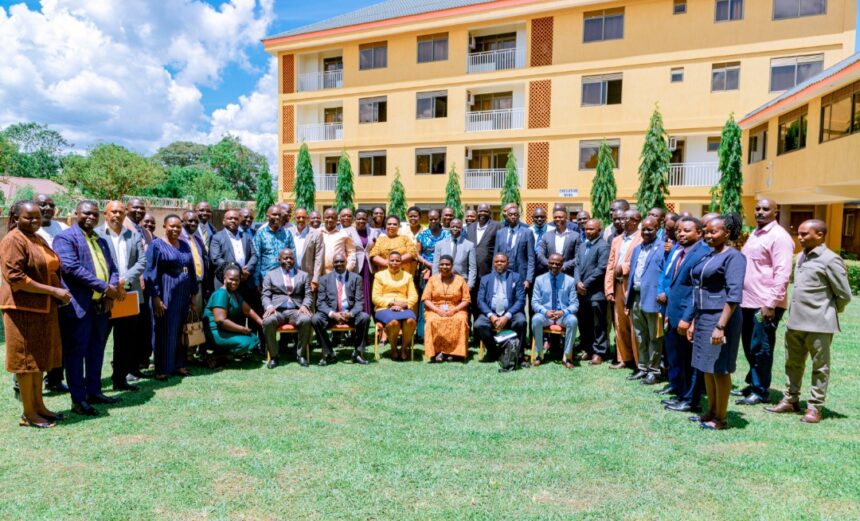
The Minister who was represented by the Minister of State for Economic Monitoring, Hon. Beatrice Akello Akori, made the remarks today while opening a 3-day capacity building workshop for RDCs/RCC, Deputy RDCs/RCCs, Assistant RDCs/RCCs, RISOs and DISOs in Lango, held at Margarita Palace Hotel, Lira City.
According to Hon. Babalanda, RDCs and Internal Security Officers are the eyes and ears of the President in the districts and they are therefore expected to ensure that government programs are implemented efficiently and the public resources are used for the benefit of the people.
“You must remain vigilant and proactive in identifying bottlenecks that affect service delivery. Where there’s misuse of public funds, poor implementation of projects, or delays in service delivery, you must take appropriate action and report to the relevant authorities,” she stated.
“If it requires you to physically visit project sites, interact with beneficiaries, verify progress and ensure that what is reported on paper reflects what is happening on the ground.”
Hon. Babalanda also emphasized the popularization of government programs, noting that many transformative initiatives introduced by the government are not fully utilized simply because the intended beneficiaries do not fully understand them.
“Programs such as the Parish Development Model (PDM), Emyooga, Youth Livelihood program, and other wealth creation initiatives are designed to move households from subsistence to commercial production. However, their success depends on effective communication and Mobilization at the grassroot level,” she said.
“As government representatives, you must ensure that communities are well informed about these programs and that eligible beneficiaries are able to access them. You must also guide local leaders to ensure that these programs are implemented transparently and fairly.”
Hon. Babalanda further reminded the commissioners of the achievements that have been realized in the Lango sub region under the leadership of the NRM government, explaining that over the years, the region has experienced significant improvements in infrastructure, including road networks, electricity expansion and improved access to social services.
“The government has invested heavily in education through the Universal Primary Education and Universal Secondary Education programs, which have enabled many children from the region to access schooling. The health sector has also expanded with construction and upgrading of health facilities across the region,” she noted.
“In addition, the government wealth creation programs continue to provide opportunities for households to improve their livelihoods and participate in the broader national economy. These achievements demonstrate the commitment of the NRM government to ensuring inclusive development across all regions of the country, including those that historically faced development challenges.”
On the issue of peace and stability, she said the element remains the foundation of development. The Minister asserted that without peace, there can be no meaningful progress.
“As security and administrative leaders, you must continue to promote peaceful coexistence among communities and ensure that disputes are resolved through dialogue and lawful processes,” she said.
“You must also remain alert to emerging security threats and work closely with other security agencies to ensure that the stability that Uganda enjoys today is preserved.
On the other hand, Hon. Babalanda congratulated President Museveni for the victory registered in the recently concluded general elections. She said the results of the elections clearly demonstrated the continued confidence that Ugandans have in the leadership of the President and in policies of the NRM government.
“I also wish to highlight the remarkable political shift that has taken place in the Lango sub-region. Historically, Lango was regarded as a stronghold of the opposition politics, particularly of the Uganda People’s Congress. However, in the just concluded elections, the NRM registered a very strong performance across the region.”
The head of the RDC Secretariat, Maj. Martha Asiimwe congratulated the commissioners and DISOs for fighting tooth and nail to ensure that the NRM government gains are protected by mobilising residents to vote President Museveni highly in the just concluded general elections.
She also highlighted the objectives of the capacity building workshop.
Maj. Asiimwe said the workshop aims at equipping the participants with relevant skills and knowledge to enable them execute their duties effectively and efficiently.
She also noted that the meeting is meant to enhance leadership development and team building to ensure effectiveness as they accomplish the intent of the Commander-in-Chief of achieving socio-economic transformation of Uganda.
“The workshop helps to strengthen personal growth, ethics, and improve your performance to make sure what you have been assigned to do is done,” Maj. Asiimwe urged.
“During the workshop, we encourage you to be innovative and creative with new ideas for the betterment of your working stations.”
As chairpersons and Secretaries of the District Security Committees, Maj. Asiimwe revealed that the participants are also engaged on security management and security geopolitical emerging threats and how to deal with them.
Additionally, she requested the Minister to maintain the current RDCs to serve the government more.
The Assistant Commissioner in charge of Economic Monitoring- Office of the President, Mr. Felix Olum, who presented a paper on Monitoring and Evaluation, highlighted some of the key service delivery concerns in the districts such as drug stock-outs, absenteeism, functionality of water points, poor state of feeder roads, urban planning chaos, low recovery rates for wealth creation funds.
He also pointed out some of the root causes for the concerns as limited Monitoring, corruption and linkages and inadequate fiscal autonomy.
“Monitoring and Evaluation of government services should be strengthened for improved service delivery. To this end, following their monitoring activities, RDCs are required to produce and submit reports to the Office of the President for review and further management,” Mr. Olum said.
“Monitoring is a routine tracking of progress of ongoing local government projects/services by comparing actual performance/achievement with planned service delivery targets and measuring actual results against expected results.”
Do you have a story in your community or an opinion to share with us: Email us at Submit an Article