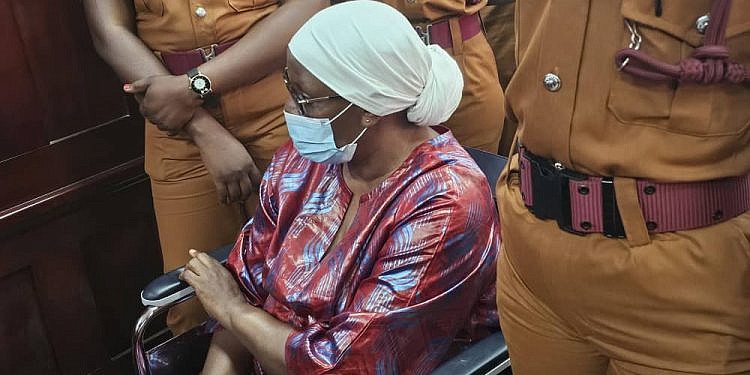
KAMPALA, Uganda — The prosecution has concluded its case in the murder trial of prominent businessman Henry Katanga, resting its evidence after calling 25 witnesses to the stand. The state, through the Directorate of Public Prosecutions, officially informed High Court Judge Comfort Rosette Kania that the presented evidence warrants putting all five accused on their defense.
The defense team for the principal accused, widow Molly Katanga, her daughters Martha Nkwanzi and Patricia Kakwanza, family worker George Amanyire, and nursing officer Charles Otai, is now poised to file written submissions to demonstrate the prosecution’s failure to establish a prima facie case. The defense will argue the state’s evidence, when scrutinized, is so riddled with inconsistencies and investigative failures that it is incapable of proving guilt beyond a reasonable doubt. Judge Kania is scheduled to rule on whether the accused have a case to answer on Feb. 19, 2026.
Cross-examination by the defense has exposed procedural breaches and fundamental flaws that are likely to form the core of the defense’s strategy. The testimony of Dr. Moses Byaruhanga, a senior police pathologist also director of Police Medical Services, who examined Molly Katanga days after the incident, is a significant pivot for the defense.
Dr. Byaruhanga stated that the severe injuries she sustained—including multiple stitched wounds and a fractured forearm requiring a steel pin, totaling more than 60 stitches across her head, arms, and upper body—were consistent with a person defending themselves from a traumatic event. While the prosecution used the presence of violence to bolster the homicide theory, the defense team, led by McDusman Kabega, Peter Kabatsi, and Elison Karuhanga, have since urged the doctor’s assessment of defensive wounds to support a claim of self-defense or sudden heat of passion, directly challenging the charge of malice aforethought required for murder.
Dr. Byaruhanga stressed that his findings were not conclusive, but suggested “defense wounds”—injuries typically sustained when someone raises their arms or shields their body from blows.
The scientific evidence, crucial to identifying the shooter and establishing the nature of the event, has been significantly challenged. Andrew Mubiru, the Director of Forensic Science, was confronted on his testimony that while Molly Katanga’s DNA was a major contributor found on the pistol, the forensic results indicated the presence of DNA from more than three contributors on the weapon, particularly the trigger and trigger housing.
No examination of finger prints was done on the trigger – something that undermines the reliance on the DNA testing.
The defense argued this was an investigative failure, as the identities of the other contributors were not established, suggesting the possibility of a person outside the accused group having handled the weapon. Testimony regarding the firearm, a black Zastava pistol, was questioned as the state failed to recover the fatal projectile, which is an essential piece of evidence for a conclusive ballistic link. Furthermore, a police officer conceded that he was unsure if the pistol he recovered was ever tested for gunshot residue on the deceased’s body.
Clement Otiti, a police bloodstain expert, testified that the blood spatter patterns in the master bedroom indicated violent movements. The defense will counter that while this proves a struggle or commotion, it does not confirm homicide or the identity of the shooter, arguing the findings are consistent with a fierce domestic brawl or an individual fighting for their life.
Police investigators and civilian witnesses became targets of intense scrutiny over their professional conduct and inconsistent record-keeping.
Police officers who were the first to respond faced intense scrutiny. Assistant Superintendent of Police Peter Ogwang’s credibility was challenged after his testimony in court contained details, such as a reported attempt by an accused to categorize the incident as an accident, that were omitted from his official police statements.
The defense argued such selective or forgetful testimony undermines the reliability of the investigation. The defense also pressed investigators over a theory of a “third party” being involved in the aftermath of the shooting, which arose from observations of evidence destruction or cleanup.
The defense will use this internally suspected possibility, which was never formally pursued or disproved, to argue that the prosecution focused prematurely on the accused without ruling out all other possibilities. First responders were also alleged to have failed to adhere to strict crime scene integrity, risking contamination of exhibits.
Defense counsel pressed Dr. Richard Ambayo on his qualifications, revealing he neither holds a degree in forensic pathology nor has completed a fellowship in the field. The defense also pointed out that his post-mortem report was dated Nov. 2, 2023, the day the body was brought in, but the witness admitted it was not the day the report was finalized, suggesting it was the mortuary’s policy to use the body’s arrival date.
The defense highlighted omissions in the post-mortem report, noting the lack of detail on beveling and an inability to distinguish the entry and exit wounds other than by size. They asserted that the lacerations on the right wound matched the descriptions of an entry wound according to authoritative texts, suggesting the pathologist failed to make accurate deductions central to the case. Dr. Ambayo was also accused of leaking the report to UPDF soldiers before its official release.
Witnesses intended to establish motive or circumstantial evidence were effectively challenged on their own credibility. Naome Nyangweso, the deceased’s sister, claimed the deceased had warned her that his wife wanted to kill him.
Lawyers pointed out this specific claim was not recorded in her initial police statements. Her credibility was further damaged when she claimed she could only testify in Runyankole, yet the defense presented her official police statements, which were all written and signed in English.
The testimony of house help George Amanyire, one of the co-accused, detailed the events leading up to the shooting as a violent domestic altercation. Amanyire recounted that on the morning of Nov. 2, 2023, he heard loud noises, shouting, crying, and the sounds of someone being beaten with a stick from the upstairs bedroom.
He and a colleague tried to intervene, but the fighting resumed. He said Mr. Katanga only spoke once, to ask who was at the door, but continued beating his wife. Shortly after, they heard a loud noise described as “something like glass breaking,” twice.
Amanyire later found Molly Katanga naked and covered in blood in an adjacent bathroom, and she told him she had bled so much and was going to die. During cross-examination, the defense questioned the witness who transcribed Amanyire’s crime scene reconstruction video about a crucial omission—that Molly Katanga said she was going to die—which was present in the video but missing from the transcript.
The defense is prepared to use this body of inconsistencies and procedural lapses to argue that the prosecution’s evidence does not meet the legal threshold for a conviction, emphasizing the lack of a prima facie case.
Do you have a story in your community or an opinion to share with us: Email us at Submit an Article