By Watchdog Uganda Reporter
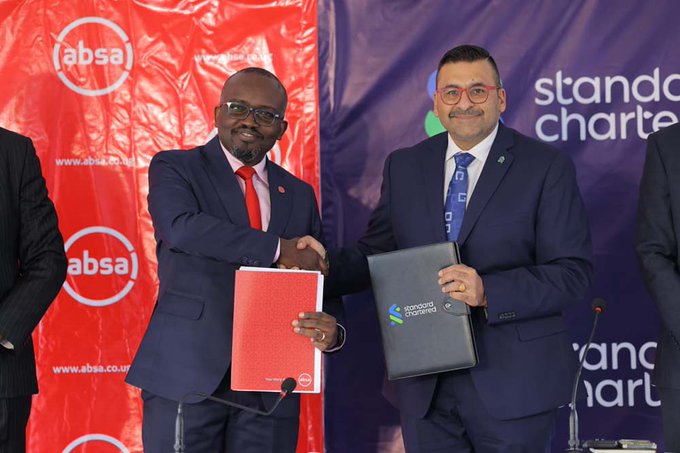
Kampala, Uganda – In a significant development within Uganda’s banking sector, Standard Chartered Bank Uganda has agreed to sell its Wealth and Retail Banking (WRB) business to Absa Bank Uganda, marking a strategic shift that will see the British banking giant withdraw from the country’s retail banking market while maintaining its corporate and institutional banking operations.
The transaction, first announced in October 2025, forms part of Standard Chartered Group’s broader global restructuring strategy aimed at streamlining operations and concentrating on higher-margin business segments, including Corporate and Institutional Banking (CIB), trade finance, treasury services, and investment banking.
Under the agreement, Absa Bank Uganda will acquire Standard Chartered’s retail and wealth management portfolio, including customer accounts, deposits, loans, selected assets, and employees attached to the WRB division. The transition is expected to be completed following regulatory approvals and operational integration processes.
Strategic Refocus Rather Than Full Exit
Although Standard Chartered has emphasized that it is not entirely leaving Uganda, the sale represents a major shift in its local business model. Going forward, the bank will focus exclusively on serving multinational corporations, large local enterprises, development institutions, and other corporate clients through its Corporate and Institutional Banking division.
The move aligns with Standard Chartered’s long-term strategy of leveraging its strengths across the Asia-Africa trade corridor and prioritizing markets and business segments that generate stronger returns on capital.
Banking analysts, however, note that the divestiture effectively removes the bank from direct competition in Uganda’s retail banking space, where customers increasingly demand extensive branch networks, digital banking solutions, and highly competitive lending products.
“This is more of a strategic recalibration than a complete withdrawal,” a senior banking industry source told Watchdog Uganda. “Retail banking requires substantial investment in technology, branch expansion, customer acquisition, and compliance. Standard Chartered appears to have concluded that its comparative advantage lies in high-value corporate and institutional transactions.”
What the Deal Means for Customers
The acquisition is expected to have minimal disruption for customers and employees.
Retail Customers: Individuals holding savings accounts, current accounts, personal loans, credit cards, mortgages, and wealth management products under Standard Chartered’s retail division will be transferred to Absa Bank Uganda. Both institutions have indicated that customer accounts will remain operational throughout the transition period.
Employees: Staff members working within the Wealth and Retail Banking division are expected to transfer to Absa, providing continuity of service and helping preserve jobs during the integration process.
Market Competition: The acquisition significantly strengthens Absa Bank Uganda’s position in the local banking industry, increasing its customer base, deposits, and retail footprint. Industry observers believe the deal could elevate Absa further among Uganda’s leading commercial banks.
A Changing Banking Landscape
Standard Chartered has maintained a presence in Uganda for decades and is widely recognized for its role in trade finance, corporate banking, treasury services, and financial innovation. Its decision to scale back retail operations comes amid growing competition from digital banking platforms, fintech firms, and mobile money operators that have transformed the way Ugandans access financial services.
The banking industry is also navigating a challenging economic environment characterized by rising operational costs, evolving regulatory requirements, and increased demand for digital-first banking solutions.
Officials from the Ministry of Finance and the Bank of Uganda have not yet issued detailed public statements regarding the long-term implications of the transaction. However, the central bank is expected to closely supervise the transfer process to ensure financial stability and protect customer interests.
Part of a Broader African Trend
Standard Chartered’s move mirrors a wider trend among several international banks reassessing their retail banking footprints across Africa. Faced with changing market dynamics and pressure to improve shareholder returns, many global financial institutions have increasingly shifted their focus toward corporate banking, wealth management, and specialized financial services.
The strategy has been championed by Standard Chartered Group CEO Bill Winters, who has led a global transformation programme aimed at improving profitability and operational efficiency across the bank’s international network.
As the transition unfolds, industry stakeholders will be watching closely to assess its impact on customers, employees, competition, and the broader financial services landscape in Uganda.
Watchdog Uganda will continue to monitor developments and provide updates on the transition, regulatory approvals, and any implications for customers and staff.
Do you have a story in your community or an opinion to share with us: Email us at Submit an Article