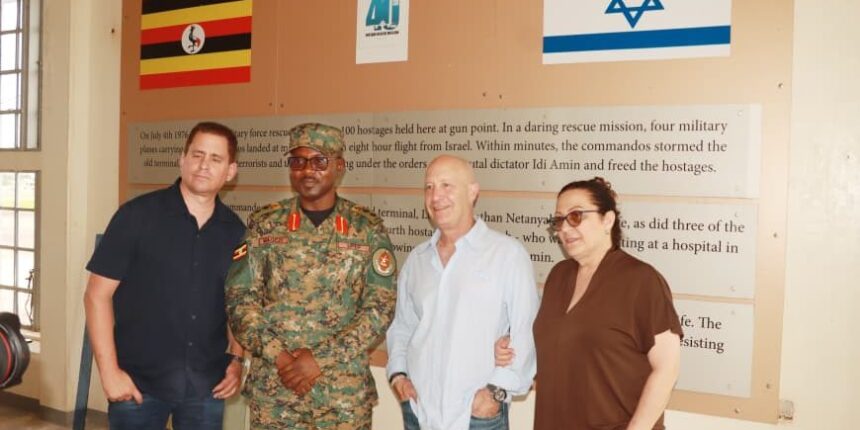
Three former Israeli hostages have returned to Uganda and visited the old airport terminal at Entebbe International Airport, nearly 50 years after they were held there during the 1976 hijacking incident that ended in a dramatic rescue operation.
They included Benny Davidson, who was 13 at the time of the ordeal, Shay Gross, then aged six, and Tzipi (Cohen) Gonen, who was eight years old. The three stood on the same grounds where they were once held alongside other passengers during the hijacking of an Air France aircraft in June 1976.
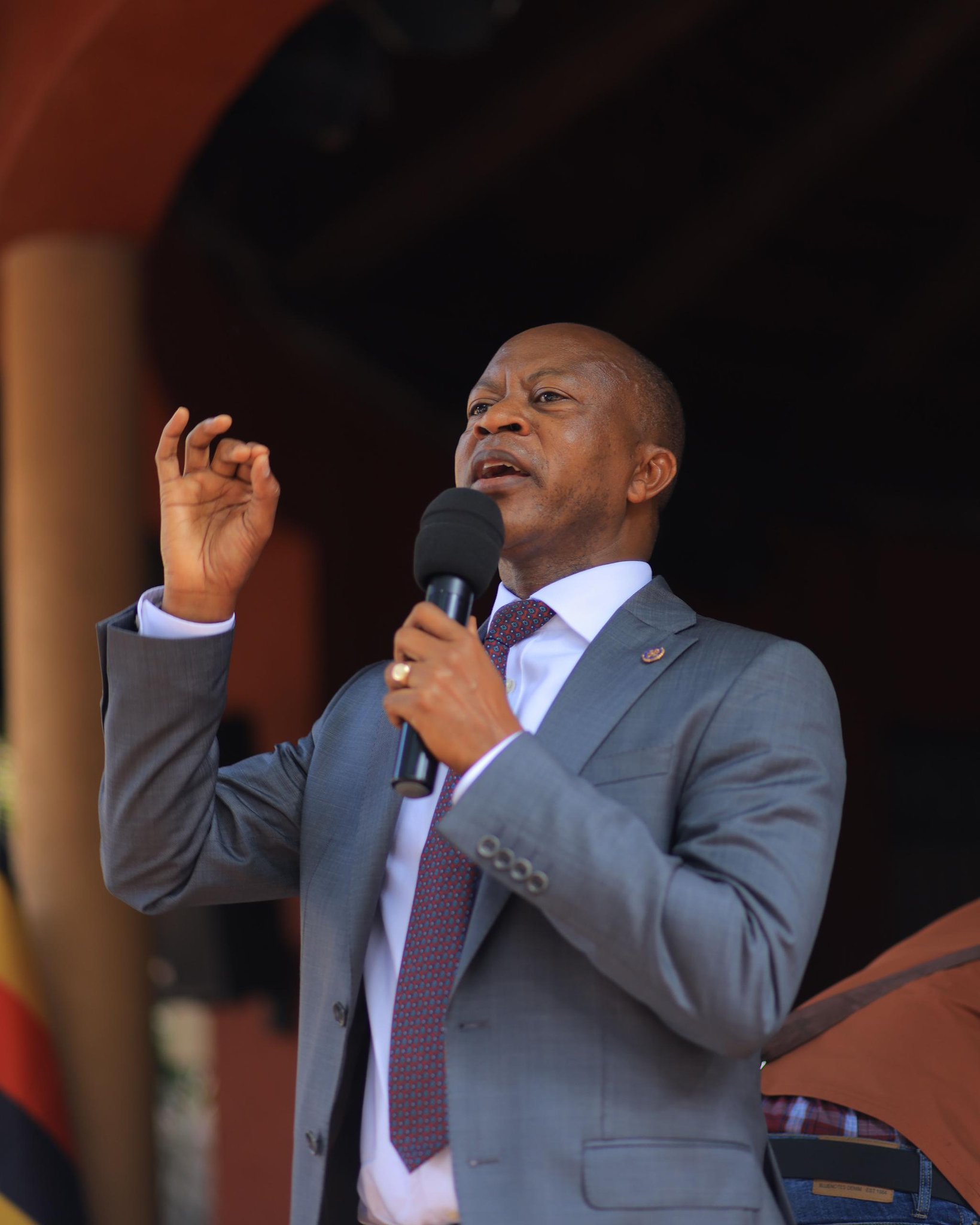
The trio were received by the Acting Director of Defence Public Information, Colonel Chris Magezi.
On 27 June 1976, an Air France Airbus A300 flying from Tel Aviv to Paris, with a scheduled stop in Athens, was hijacked by members of the Popular Front for the Liberation of Palestine–External Operations and German militants. The aircraft was diverted first to Libya and later to Uganda, where it landed at Entebbe International Airport. The hijackers were later joined by additional accomplices on the ground.
The group was reportedly supported by the then Ugandan leadership under Idi Amin. Over the following days, non-Israeli passengers were separated and released, while the remaining hostages, mostly Israelis and members of the Air France crew, continued to be held at the old terminal building.
At the height of the crisis, Israel launched a military rescue mission known as Operation Entebbe, also referred to as Operation Thunderbolt. The operation took place in the early hours of 4 July 1976 and ended the hostage situation.
Speaking during the visit, emotions ran high as Tzipi (Cohen) Gonen recounted the trauma of the events, including the loss of her father during the crisis. She described the day as one that changed her life permanently.
“My father was shot dead. My brother was missing at the time. In the confusion of the exchange of fire, I never knew whether he was killed by Ugandan soldiers or during the rescue operation,” she said.
She explained that returning to Uganda was deeply personal, saying it allowed her to close a painful chapter and honour her father’s memory. She added that she had lived with the experience since childhood and had only recently found the strength to speak about it publicly.
Benny Davidson also reflected on the memories of that night, describing the emotional weight of returning to the same location.
“The moment I walked in, the memories came back as if it was yesterday. I could still picture everything clearly,” he said.
He further observed that Uganda today presents a very different image from the country he remembers from 1976, noting the warmth of the reception and the changed nature of the armed forces.
The Acting Director of Defence Public Information, Col Chris Magezi, described Uganda’s openness to visitors interested in engaging with the historical significance of the site.
“Uganda is open, welcoming, and ready to receive anyone who wishes to visit the old terminal, where these events once took place,” he said.
He described the 1976 hostage crisis as a painful chapter in Uganda’s history and a defining moment in global counterterrorism operations. He added that the outcome of the rescue demonstrated that acts of terror do not prevail over determined international cooperation.
Col Magezi also reflected on the broader significance of the events, noting that Israel’s resilience as a nation had enabled it to overcome repeated security challenges over time.
He emphasised that while the incident remains a difficult part of Uganda’s past, it also serves as a reminder of the importance of peace, stability, and international cooperation.
Today, the old terminal at Entebbe stands as a historical site marked by memories of fear, loss, and a dramatic rescue that has since become one of the most studied counterterrorism operations in modern history.
Do you have a story in your community or an opinion to share with us: Email us at Submit an Article