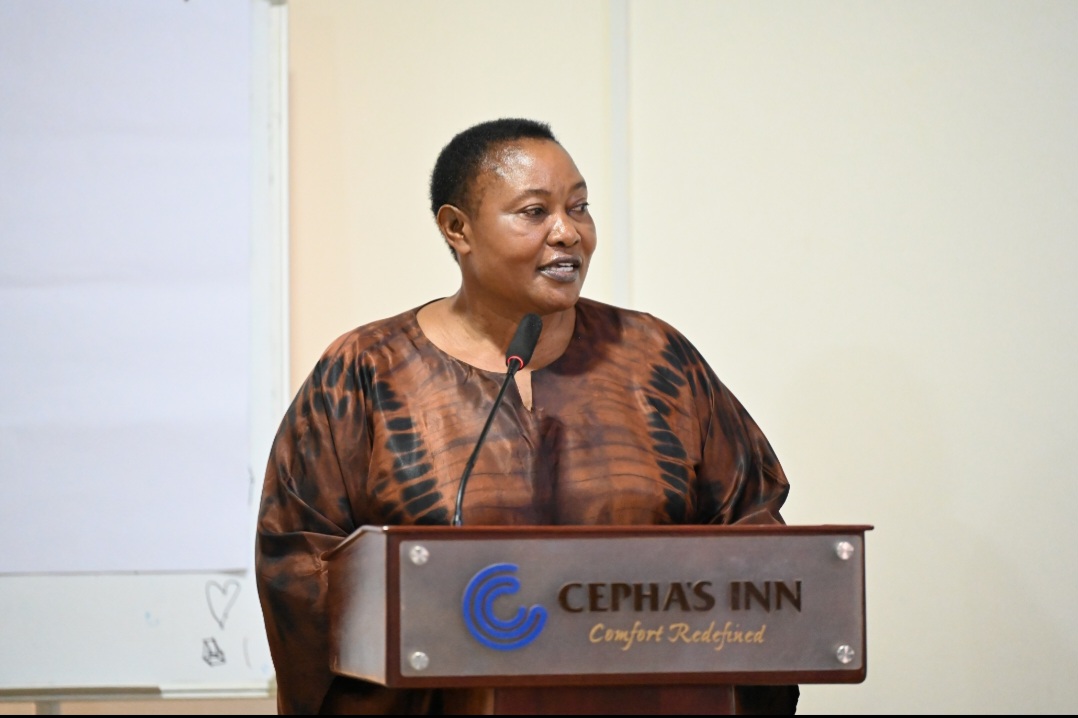

Hon. Janet Kainembabazi Museveni Kataaha, Minister of Education and Sports (MoES)
Dear Hon. Minister,
With heartfelt appreciation, I celebrate the exemplary leadership as, Minister of Education and Sports, First Lady of the Republic of Uganda, devoted wife to H.E. Yoweri Kaguta Museveni, and truly the mother of the nation. You have shown that when duty calls, you not only answer you rewrite the script. By initiating the Competency-Based Curriculum (CBC), you planted seeds whose fruits are already nourishing a new generation of innovators and problem-solvers. As the saying goes, “where there is a will, there is a way,” and you have paved that way with wisdom, grace, and unwavering commitment. Balancing national leadership and family with such poise proves that you do not just wear many hats you wear them elegantly.
With a lion’s courage and a mother’s gentle heart, you have steered the education sector with clarity and conviction, reminding us that true leadership is both firm and compassionate. We raise our voices in the highest praise and say thank you for lighting the torch that will guide Uganda’s future.
Permit me, with scholarly respect and patriotic candor, to pose a question that lingers in staffrooms, university lecture halls, and village trading centers alike: Has Uganda’s Competency-Based Curriculum (CBC) become a genuine revolution, or are we pouring new wine into old bottles and wondering why the taste feels familiar?
The reform, as championed by the National Curriculum Development Centre through guidance of Hon. Janet, was nothing short of audacious. It promised to dethrone rote memorization and enthrone competence. It sought to replace the parrot with the problem-solver, the crammer with the creator. It aligned itself nobly with Uganda Vision 2040 that grand blueprint envisioning a skilled, innovative, self-reliant human capital force.
The intentions were clear and commendable:
To tackle youth unemployment through skill acquisition and employment readiness.
To shift from teacher monologues to learner-centered pedagogy.
To nurture holistic development communication, collaboration, digital literacy, self-direction.
To promote integration and application of knowledge to solve real-life societal problems.
To improve assessment through formative and continuous evaluation of mastery.
To embrace digital transformation, bridging resource gaps with ICT-enabled instruction.
In short, CBC promised to move Uganda from a knowledge economy in theory to a competence economy in practice.
Indeed, feedback from visits to several secondary schools across the country shows many commendable outcomes of the Competency-Based Curriculum (CBC).
Students are developing impressive, practical projects, including small businesses such as producing organic herbicides from local plant materials, establishing kitchen gardens, creating school-based science kits, developing malaria diagnostic aids, making soap, producing reusable menstrual kits, painting murals, and designing maps for local area mapping, among others.
In addition, students complete school-based projects are assessed at school outcome are submitted to Uganda National Examinations Board (UNEB).
However, an important question arises: what happens to these projects after they are marked and ranked? Reports from schools suggest that the emphasis on ranking has led some teachers and schools to generate projects on behalf of students in order to achieve higher scores. This undermines the core intention of the curriculum, which is to nurture students’ original, self-initiated ideas and innovation.
Students and teachers are supposed to be nurtured, trained, and mentored: providing structured business mentorship to students and young entrepreneurs from Senior 1 through Senior 4, A-Level, and university has measurable academic and economic impact. According to the Global Entrepreneurship Monitor, young people who receive entrepreneurship education and mentorship are up to 1.5 times more likely to start a business compared to those without support, while data from the World Bank shows that youth-owned enterprises can contribute significantly to job creation in developing economies, where SMEs account for nearly 90% of businesses and over 50% of employment. Early mentorship strengthens financial literacy, leadership, and problem-solving skills competencies the World Economic Forum identifies among the top future workforce skills while longitudinal studies linked to Junior Achievement programs indicate that students exposed to entrepreneurship education are more likely to complete higher education and report higher lifetime earnings. By introducing mentorship as early as secondary school (S1–S4) and sustaining it through A-Level and university, institutions create a pipeline of innovation-ready graduates who are not only job seekers but job creators, increasing economic resilience, reducing youth unemployment, and fostering sustainable community development.
Yet, Hon. Minister, revolutions are not declared they are demonstrated. Some reflections
The Paradox of Grades in an Age of Competence
While the curriculum language has changed, the ecosystem of incentives remains stubbornly intact. Schools are still ranked by the alphabet harvest A’s and B’s stacked like trophies on a national scoreboard. “Top schools” are those with glittering aggregates, not necessarily those with glittering innovations.
The headlines after examination results do not read:
“School X Launches 1000 Student Startups”
“School Y Designs Low-Cost Irrigation System”
“School Z Creates 700 Community Jobs”
Instead, they trumpet:
“School X Scoops 50 A’s.”
In such a climate, teachers teach to the test, students memorize to survive, and administrators chase distinctions as though competence were an extracurricular activity.
We preach formative assessment but worship summative judgment.
We advocate creativity but reward conformity.
We speak of entrepreneurship but certify theoretical abstraction. If grades remain the gold standard, competencies will remain silverware polished but peripheral.
Has CBC Achieved Its Intended Outcomes?
Allow me to ask directly:
Has youth unemployment significantly declined due to secondary school CBC implementation?
Are we systematically tracking student-led enterprises emerging from schools?
Are schools evaluated based on innovation outputs, patents, startups, or community problem-solving?
Has ranking expanded to include economic and social impact indicators?
If the answers are uncertain, then the reform risks becoming curricular cosmetics new vocabulary painted over old structures.
My expectation perhaps ambitious, but aligned with the mission of Quality Education Consultancy Ltd(QECL) and OPUL Skilling Foundation Africa (OSFA), whose motto is “Innovative Skilling as Medicine to Extreme Poverty” With long-term ambition to facilitate 20 million business start-ups, Accelerations, Innovations and create 40 million decent jobs by 2035. With CBC school ranking would evolve to include:
Number of student /Teachers business startups incubated.
Number of businesses accelerated beyond survival stage.
Number of innovations developed and prototyped.
Number of jobs created by alumni within five years.
Amount of revenue generated through school-based enterprises.
Number of households or communities lifted out of poverty through student initiatives. Without such metrics, we are measuring the height of the tree while ignoring whether it bears fruit.
Alignment with NDP IV, Revenue Imperatives and Uganda’s Tenfold Growth Strategy
The National Planning Authority, under the Fourth National Development Plan (NDP IV), emphasizes industrialization, private sector growth, job creation, and enhanced domestic revenue mobilization. The plan seeks to raise household incomes and expand Uganda’s tax base.
Similarly, the Uganda Revenue Authority (URA) Revenue Enhancement Strategy underscores broadening the tax base, formalizing enterprises, and nurturing compliant, productive economic actors.
Uganda’s Tenfold Growth Strategy is an ambitious national development blueprint designed to expand the country’s economy from approximately US$50 billion (in 2023/24) to US$500 billion by 2040. Aiming for a tenfold increase in 15 years, the strategy focuses on rapid, sustainable development through four key sectors (ATMS): Agro-industrialization, Tourism development, Mineral-based development (including oil and gas), and Science, Technology & Innovation, including ICT.
Here lies the policy irony: If CBC truly produces entrepreneurial, innovation-driven graduates, it should be feeding directly into: NDP IV’s targets on industrial growth and employment, URA’s goals on revenue expansion, Uganda’s Tenfold Growth Strategy, Uganda’s MSME development strategies and National science, technology, and innovation frameworks. But if secondary schools remain examination factories, then CBC becomes a decorative annex to NDP IV rather than its engine room. Education must not merely produce job seekers it must produce taxpayers, employers, inventors, exporters. Otherwise, we are educating for applause, not productivity.
Lessons from Other Jurisdictions
Countries that have embraced competency-based models did not merely revise syllabi they redesigned accountability systems.
In Finland, holistic assessment and project-based learning are supported by minimal standardized ranking culture. Trust in teachers and integration across disciplines enable authentic competence development.
In Singapore, reforms under “Thinking Schools, Learning Nation” aligned curriculum, assessment, and teacher professional development, ensuring that critical thinking was not rhetorical but examinable and measurable.
The lesson is simple yet profound: curriculum reform without systemic reform is like installing a new engine in a car with square wheels.
Uganda can learn that:
Assessment reform must accompany curricular reform.
Teacher capacity building must be continuous, not episodic.
Public perception of excellence must be reshaped.
Economic impact indicators should inform educational evaluation.
Structural Contradictions Undermining CBC
Several tensions remain:
Examination Dominance; National examinations still determine prestige and progression.
Teacher Preparedness Gaps Many educators remain products of rote systems now expected to engineer creativity.
Digital Inequality: ICT integration remains uneven across rural and urban settings.
Cultural and school Expectations: Parents and schools equate academic distinction with success, while vocational or entrepreneurial pathways remain undervalued.
Thus, CBC operates within a gravitational field pulling it back toward traditionalism
Recommendations to the Ministry of Education and Sports Hon. Minister, transformation requires courage to recalibrate incentives.
1. Redefine School Ranking Frameworks
Incorporate: Innovation indices, Entrepreneurship incubation statistics, Community impact scores, Employment and alumni tracer data
2. Reform National Assessment Architecture
Ensure that continuous assessment meaningfully contributes to certification and cannot be overshadowed by final exams.
3. Institutionalize School-Based Enterprise Hubs
Every secondary school should operate as a micro-innovation ecosystem agricultural projects, tech labs, manufacturing prototypes linked to local economies.
4. Launch a National Competency Impact Report
Annually publish data on: Student and teachers enterprises, Jobs created, Revenue generated and Social problems solved
5. Strengthen Teacher Professional Identity
Transition teachers from “content deliverers” to “learning designers” through structured mentorship and performance incentives tied to competency outcomes.
6. Bridge the Digital Divide
Guarantee infrastructure parity to prevent CBC from becoming an urban privilege.
Conclusion: The Bottle Must Change
Hon. Minister, CBC is not the problem; misalignment is. The philosophy is sound. The aspirations are noble. But unless the surrounding structures ranking systems, public recognition, accountability frameworks evolve, we risk staging reform while preserving tradition.
New wine deserves new bottles.
If we succeed, Uganda will produce not only graduates with distinctions, but world class innovators with direction; not merely certificate holders, but job creators; not merely academic achievers, but architects of prosperity.
History will judge this reform not by policy documents, but by poverty statistics, enterprise growth, and national productivity. May we have the courage to let competence, not mere grades, define excellence.
With profound respect and unwavering commitment to Uganda’s educational transformation.
Dr. OPUL Joseph, PhD
Lecturer, Faculty of Education and Humanities , Gulu University
Director, Quality Education Consultancy Ltd (QECL)
Founder, OPUL Skilling Foundation Africa (OSFA)
ceo@opulskillingfoundationafrica.org
regionaldirector@qualityeducationconsultancylimited.com
Do you have a story in your community or an opinion to share with us: Email us at Submit an Article