An armed conflict has got four levels: a war; a campaign;an operation; and a battle. All these levels can either be short, like the 6 days war of 1967 between Israel and the Arabs or a protracted one such as the 30 years war between the Protestants and the Roman Catholics in Germany, the 100 years War between England and France, the 1st and 2nd World Wars between Germany and its allies and Britain, Russia, the USA and its allies.
In the case of Uganda, the second Resistance War started on the 6th of February, 1981 and major battles ended with the capture of Kampala on the 26th of January, 1986. Within that 5 years’ War, there were four campaigns, a number of operations and many battles.
A war means the whole conflict, from the beginning to the end ─ in this case from Kabaamba on the 6th of February to Kampala, the 26th of January, 1986.
The campaigns were four:
– The gun-raising campaign from the 6th of February, 1981, to September, 1985, when, in addition to the 4,000 rifles we had captured from the UNLA, we received the 5,000 rifles from Mwalimu with 1,000,000 rounds of ammunition and the 800 rifles we had received from Gaddaffi, with 800,000 rounds of ammunition.
– The second campaign was the campaign to open the second front in the Rwenzori Mountains, starting in March, 1985, until the battle of Rubona in June, 1985.
– The third campaign was the expansion that started in September, 1985, with the massive recruitment of fighters from Western Uganda that boosted the NRA from 4,000 fighters to 20,000 (fresh recruits and UNLA captured soldiers being integrated into the Resistance War).
All these 3 campaigns were within the strategic Defensive Phase ─ when the resistance was on the defensive, but fighting offensive battles and operations within the strategic defence.
– The 4th campaign coincided with the opening of the strategic counter-offensive on the 17th of January, 1986. Our forces, advancing on five axises (routes), swept towards Kampala in the centre and Masindi and Karuma in the West.
The axises were: Kampala-Masaka Road (1st Battalion ─ Pecos and Mugisha Fred, 5th Battalion ─ Kashaka and Kashillingi); Kinoni-Mpigi Road and Mityana Road axis ─ 7th Battalion ─ Kyaligonza and Stanley Muhangyi; Hoima Road axis ─ 11th Battalion ─ Chefe Ali; Bombo road-blocking ─ 13th Battalion ─ Ivan Koreta; the Western Axis ─ Hoima-Masindi ─ Tinyefuuza ─ Peter Kerim, with the 19th Battalion. The 3rd Battalion, under Lumumba, was in Reserve with me and Saleh, 21st Battalion was in Reserve at Kasese and the 9th Battalion was in Reserve at Kabale-Kigyezi. The 9th Battalion was under Julius Kihaanda and the 21st Battalion was under Benon Tumukunde in Kasese, watching the suspected moves of Mobutu in Congo. The 15th Battalion, under Samson Mande, was created. I am referring to these forces as battalions, but, in reality, they were Regiments ─ equivalent to two of our present day battalions of 736 persons each. One of them, the 19th Battalion under Peter Kerim, was 1,900 fighters. The others were, on the average, 1,500 persons. We had done this deliberately so as to economize on the leadership resources (commanding officers) that were not so plentiful. If you have one good CO, why do you only put 5 companies, 146 persons each, under him? Why does he not provide leadership for 10 or more companies? This battalion will then, do work for 2/3 of a brigade (3 battalions), but under the leadership of the one good leader.
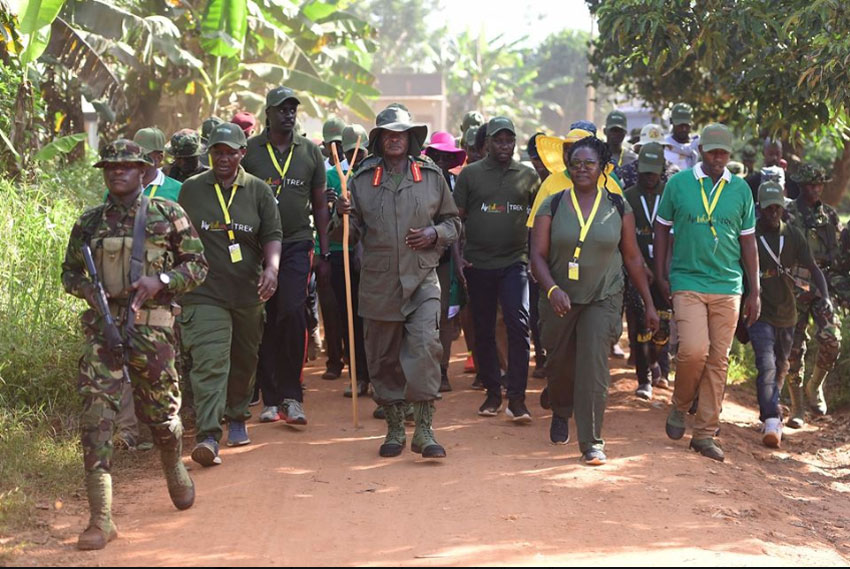
This trek, therefore, is on just a portion of one of the Operations ─ the Kabaamba Operation. This was within the campaign of gun-raising. The Operation started on the 22nd of December, 1985, from Sebuguzi ─ involving 1,500 fighters ─ armed and unarmed. I, personally, oversaw this operation, with Saleh as the Operational Commander of the force. This was the Mobile Brigade comprised of: 1st, 3rd and 5th Battalions, with alot of commandos (unarmed fighters).
The Kabaamba III was aimed at capturing the rifles that Fronasa had handed to the UNLA following the merger after the defeat of Idi Amin in 1979. Twice, we had, unsuccessfully, tried to capture these guns ─ on the 6th of February, 1981 and, again, in Safari ─ 50 of 1983 ─ April-May. On the 20th of February, 1984, we had, successfully, captured the 760 rifles of Masindi and alot of other weapons, boosting the gun level of the NRA from 600 guns to about 1,400. On the 30th of June, 1984, we had attacked Hoima and got another 60 or so rifles. We were, now, aiming for the guns of Kabaamba.
The reconnaissance had been done smartly by Mugume-Chagga, assisted by an insider, Tindibakyira. I, however, decided to postpone the operation from about November, 1984, to a later date because one of the cadres, Katabarwa, came with Eriya Kategaya and Ivan Koreta, from Nairobi and told me that he had established a peace dialogue with his military college-mate, Kagata Namiti, along with Paulo Muwanga who was the Vice-President of Obote. He wanted us to allow him to pursue the peace talks in Kampala. My question to him was: “Why Kampala?” “Why not Nairobi or elsewhere?” Katabarwa, however, was very firm that he was sure there would be no harm to him even in Kampala. Of course, I also had a lingering idea in my head about the idiocy and futility of even the confused UPC killing a peace envoy. It would not affect the struggle at all. Why would anybody do it? I, therefore, allowed Katabarwa to go to Kampala and also came with a very large force, 1,500 that we had prepared to attack Kabaamba, to Galamba to be near Kampala so that Katabarwa could come back and consult us from nearby. Galamba is only 17 miles from Kampala if you use the main road. We must have arrived there at the beginning of December, 1984. We waited for a number of days without either Katabarwa or Kyaligonza, who was the one guiding those who went to or came from Kampala, showing up. Instead, on the 10th of December, 1984, we were attacked by a UNLA force and we repulsed it. We shifted to a new position but in the same area, to an area below a two class-room primary school of that time known as Migadde Primary School. It was there, one morning, that Kyaligonza turned up and told us that Katabarwa had been killed. There was, therefore, no point in us continuing to stay in that area. As we were preparing to leave that area and head for Kabaamba, we were attacked by a large UNLA force. They could not enter the camp, but they camped at the school above us. I did not want to continue with a protracted battle for positions where we wasted ammunition without profit. The battle had gone on for about 2 days but, in the night, the whole force pulled out and by morning, the long column was marching through the Masuliita peninsula, in the area of Bbaale and ended in Ssebuguzi, near Kapeeka.
There we stayed for a day or two as we prepared for the long walk to attack Kabaamba.
The long walk started on the afternoon of the 22nd of December, 1984. The large force started crossing the swollen Mayanja River at about 1400 hours, but could not all cross until 0020 hours on the 23rd of December according to the European counting of hours, the eighth hour of the night (shaha munaana gw’ekiro) according to the African counting of hours, of day and night. The lap we had planned to cover in the night hours, was supposed to be up to Kyamusisi in Mityaana district where we had our small detach under John Kazzoora. It was only by 0800 hours (Shaha Ibiri z’akasheeshe) that we entered the Kiryookya village and turned to head for Kyamusisi. We had crossed Hoima Road at the Matte junction. All the villagers in the areas through which we passed, saw this huge column. Even one of our soldiers was captured by the UPC vigilantes. We were always monitoring Obote’s military radio-network and they started saying that a large guerrilla force, led by Museveni in person, is heading for somewhere. Where, exactly? Fortunately, on account of tightly holding information, the ordinary soldiers did not know.
The UPC, in their usual day-dreaming, started saying that we were running away ─ going to Congo, etc. I could, however, not take chances. We arrived at Kyamusisi at about 1200 hours (Shaaha Mukaaga) on the 23rd of December, 1984. We cooked, ate, etc. This time, unlike 1983, we had planned better. We had pre-dumped maize grain and beans at the stop over points: Kyamusisi, etc. Soldiers did not have to carry the grain on the march.
Nevertheless, given the exposure by the daylight march and the solider who had been captured by the UPCs, I decided not to take chances. I decided to split the force into two. Seven hundred soldiers, all armed, had to march in the nights and attack Kabaamba by a surprise dawn attack as originally planned, while the larger force of 800 fighters, only 40% of them armed, would march in the opposite direction, in daylight hours, to confuse the enemy. Possibly on Christmas day, Saleh’s force left by early evening and started on their marches by night. We stayed in the camp for one day. Then the following day, we started walking, by daylight hours, towards the Lukoola, the River Mayanja valley. We crossed Temanakali, between Nakwaaya and Bukomero and spent the night at Kamugabo.
The following day, we marched by day and camped at Kembogo. The operational commander of this force was Ahmed Kashiilingi.
On the 28th of December, 1984, a force from the UNLA in Bukomero attacked us. We repulsed them. I was now happy that our deception was working. Possibly, on the 30th of December, I moved the force to our old site of Kagaari, in Dr. Sebuliba’s farm, where we camped. We had last camped here on the 10th of February, 1981, following our being dislodged from Kagobe, near Kiboga by the Tanzanians. Around 1400 hours on New Year’s Day, 1985, the good news came through our usual informer ─ the UNLA radio-operators. A military radio message was sent, I think, from Mubeende, that, that morning a powerful enemy force had attacked Kabaamba barracks, overrun it and were still there. The force from Mubeende had made repeated counter-attacks, but had been repulsed. I immediately, called a Master-Parade of our force of 800 and conveyed the good news to the force. I, however, decided that it was late and decided to start the march to the West, the following day, the 2nd of January, 1985. On the 2nd, we moved out of the Lukoola, climbed the Ssingo hills on both sides of Hoima Road and ended up in Kyamusisi. Did we cover the distance in one day? I do not clearly, remember. However, on Bulaga hill, I fainted but Dr. Besigye gave me re-hydration salts and I resumed the march. Earlier on, in Karagwe, Tanzania, I had learnt the strain on the body when climbing hills. It is wise to have rests after short bounds; also use a support stick (empiimbo). On the Bulaga hill, I had not observed those rules.
Eventually, we established radio link with Saleh. After successfully attacking Kabaamba, he had marched West, towards Kyaaka, crossed the Mubende-Fort Portal Road at Kyegyegwa, fought battles with UNLA at Hapuuyo and continued marching and fighting. We now decided to link up in the Bugangaizi area, instead of using the Lake Wamala route that Saleh had used on the way out. By difficult marches, by day and by night, we went through Bukuya, Butoloogo, crossed Hoima-Kakumiro road at Nkoondo and camped at Kasaambya Sub-County Headquarters on the afternoon of the 8th of January, 1985. There, through the usual radio communication, we agreed with Saleh to link up at Bireembo, only 8 miles from Kasaambya Sub-county headquarters. The link was effected on the 9th of January, 1985. The Kabaamba operation/battle had been almost as successful as the Masindi one. 650 rifles, mortars, machine-guns, ammunition, etc., had been captured. It was another historic victory for the NRA.
Saleh’s force, having marched by night after night, starting with the Christmas day of 1984, had arrived at Kabaamba, having walked along the railway line, on the morning of the first day of the New Year, 1985. Seeing the huge extended-line of the NRA fighters, the UNLA soldiers had fled. The battle was now left to one soldier, who entered the underground armoury of Kabaamba and tried to imitate the heroic action of the Tanzania NCO that had blocked us with machine-gun fire on the 6th of February, 1981. Since I had been in all those efforts, I now designed a medicine for that eventuality. Out of the 100 land-mines we had got from Gaddaffi in 1981, only 4 were now remaining. The 96 landmines had been used to wreak havoc on the UNLA who stupidly insisted on using vehicles that were, really, moving coffins. Since the External Committee had failed to get additional guns out of the chaotic Libyans, we were now remaining with only 4 pieces. I decided to use one of them for this strategic task of liberating the guns Fronasa had handed in at Kabaamba in the 1979/80 unification of the armed groups. Anticipating the repetition of the Tanzanian Corporal’s actions, I decided to weaponize one of the cattle-keepers techniques. This is the technology of ekiteeko. Ekiteeko is a fibre mesh made out of the tough Kaamba (Sisal fibres). The sisal fibres (Kaamba) and ropes (emigoye, ebitsibo) are very tough. There is even a riddle (ekiito, ekishaakuzo) which goes like this: “Shaku shaku!!” The other ones (the audience) answer: “Shambagira”. I cannot translate these because, even I, do not know their meaning. It must be long lost. What we know is that this is a standard form of challenging the wits of one another with riddles (ebikokyo in Luganda) that have hidden messages and meanings. The one praising the ekiteeko goes like this, again: “Shaaku, shaaku!!” The answer is “Shambagira”. Then the riddle (ekiito ekikokyo) goes like this: “Nyabukono bukye, nyankubito egumire!!” ─ “the small armed item but with lot of strength!!” It is the ekiteeko (the sisal mesh) that holds milk-pots, ebishaabo (milk gourds ─ the big ghee ─ churning ones), ebirere (the smaller gourds for yorghurt – amakamo or skimmed milk – amachuunda). It is this “small-armed” (nyabukono bukye) but with alot of strength (nyankubito egumire), that I turned to so as to solve the problems of a possible machine-gunner in the under-ground armoury of Kabaamba. Get one of the Gaddaffi land-mines, use a car battery to create an electric current, put an electric detonator in the landmine, put the so armed land-mine in the ekiteeko, from the top of the armoury lower the mine to the mouth of the armoury (the opening) and electrically detonate it. It will stun the underground warrior and our group will assault. Apparently, my military field engineering (using explosives), worked even better. The poor fellow died by concussion. I had not anticipated that extreme result. Therefore, the under-ground armoury was overcome in that way and the weapons were safely got out. The UNLA counter-offensive, now led by Ogole and Odwar, tried to make Saleh drop the guns by incessant attacks: Hapuuyo and Kabaamba itself. The inconvenience for the Saleh group was that they were heavy – laden, not with sins as the Church hymn goes, but with the means of liberation because they were the fighters to repulse Ogole and Odwar and at the same time carry the heavy loads of weapons. Their double-burden: fight and carry. The urgent tasks now were to relieve the fighters of the burden of carrying and to expand the fighting force by arming the unarmed (the commandoes). Hence, the link up at Bireembo. When we joined with the Salehs below Bireembo Primary School, I did not like their camp-site ─ in the valley – on the banks of Nkusi River. The Bunyoro vegetation at that time was very thick with narrow paths that were like tunnels under the massed and intertwined vegetation. With people carrying heavy loads, that was a disaster waiting to happen. I ordered that we move out of the valley and camp at Bireembo Primary School where the road was wide and the Bulungi-bwansi roads were also wide and open enough. The issue here was not concealment, but ease of mobility for the heavy-laden vast column.
On the 10th of January, the force moved out of the valley and started camping at the school. At around 10:00 hours, however, Ogole and Odwar launched a heavy artillery bombardment and a ground-attack. We repulsed the attacks but the artillery killed 3 of our fighters and injured another two who died later. The battle had gone on for the whole day. Some of the shells hit near my trench. One of my close body-guards, was injured. In the night, however, we successfully pulled out and by morning, we were quite far, heading for Nkooko and Ntwetwe. We walked the whole day of the 11th, went through Nkooko in the night and entered Ntwetwe where one of our supporters ─ Kigoongo─had alot of maize grain – belonging to their Cooperative Society. I paid him for the whole maize, but told him to report to the UNLA, when we left, that the guerrillas had locked him up and grabbed his maize. The deception worked. Our supporters got their payment, we got the grain and the UNLA did not penalize our supporters because they believed the story. The UNLA came on our track towards Nkooko and were aimlessly shelling the forests of the area. At night, I think, on the 12th of January, we moved out of Ntwetwe, crossed some swamps, marched until daylight, continued marching, crossed a River called Mpongo and laid a big ambush on Bukwiiri ─ Ntwetwe Road, where we destroyed another UNLA convoy capturing more guns. Ogole came with a helicopter ─ a 206 Agusta-Bell ─ where-upon we saluted him with gun-fire. His helicopter fled. Eventually, we crossed Hoima Road at Rwamagaari and re-entered the Lukoola. Ogole and Odwar had lost the battles and the operation. We, eventually, camped at Nyambiindo and re-organized the force creating the battalions that pushed the UPC regime to its evening hours. The battalions, now reinforced with more rifles were:
1st BN ─ Pecos and Mugisha;
3rd BN ─ Lumumba;
5th BN ─ Kashaka and Kashillingi;
7th BN ─ Kyaligoonza and Muhangyi;
9th BN ─ Kihaanda;
11th BN ─ Chefe Ali.
I think, by this time, each of these battalions had 4 companies, each coy with 75 rifles. Therefore, each battalion had 300 rifles. The 6 of them, therefore, had 1,800 rifles. These did not include the rifles of the zonal units of: Black Bomber (Abdul Naser), Mondlane, Luttamaguzi, Kabaleega, Ngoma, Nkrumah and Kiwanguzi. By now, there were like two companies of the High Command unit ─ the bodyguards of CHC ─ the Chairman of the High Command. Ogole, again, flew over us and this time, we almost brought him down. After re-organizing, we marched the whole length of the Lukoola, passed Kansiri, climbed the Luanda hills, above present day Ssingo barracks and entered the Kikandwa forest on the 21st of January, 1985.
When we camped, I switched on my small radio and heard a BBC announcement saying that our Chairman, Professor Lule, had died in London. That is why I remember that date very well.
While in Kikandwa forest, we were, again, attacked by Erica Odwar, but repulsed him. After like a day, we moved out of the forest at night with our luggage and started walking along the Kirema-Kabele Bulungi-bwansi Road. The UNLA at Namirembe really shelled us with Katsyushas and the 120mm mortar. The Katsyushas, obstructed by the Namirembe hill and with the poorly trained UNLA, given their slanting elevation, were firing very far from us, hitting the Semuto area. The more dangerous were the 120mm mortar because they were firing parabolically, sometimes even almost 800. They can, therefore, loop shells over ridges and they fall right behind the ridge which is where we were marching along. However, we maintained a steady pace until we got out of range of the mortars, crossed Kabele junction and linked up with the base camp at Kikoko, beyond Migingye.
Therefore, the years 1984/5, exactly 100 years after the shameful 1884/5 that saw the Congress of Berlin where the Europeans shared out a prostrate Africa, were years of victory for the NRA. In that year of shame, the NRA, supported by the people, wrote a glorious story of heroism, sacrifice and skill. Victory for the forces of Patriotism and Pan-Africanism in Uganda was drawing near. Indeed, in June that year, 1985, two other battles took place ─ Rubona and Kembogo. Especially, the latter one, was decisive. The massed UNLA battalions were defeated by the Mobile Brigade, again under Saleh; that marked the end of the Obote regime. The defeated UNLA came to Kampala and overthrew Obote.
The Galamba-Bireembo Trek is, therefore, not the only important trek. There are others which should be marked at different times. These are: the Kanyaara-Masindi operation; the other portions of the Kabaamba operation ─ from Kyamusisi to Kabaamba –Kyaaka-Hapuuyo-Bireembo; the Hoima Operation; the opening of the 2nd Front; the sweep to the West, resulting in the envelopment of the Masaka barracks and the protracted Katoonga battle (September, 1985 to December, 1985); and others that should be identified. The Galamba-Bireembo portion, nevertheless, has some interesting elements, especially the elements of: endurance, maneuver, concealment, even when there was a leakage; and successful deception to counter-the leakage of information and a lower tempo of momentum then, previously estimated; and achieving surprise in spite of the leakage.
Yoweri Kaguta Museveni
PRESIDENT OF THE REPUBLIC OF UGANDA
Date:
Sunday, January 5, 2020
Do you have a story in your community or an opinion to share with us: Email us at Submit an Article