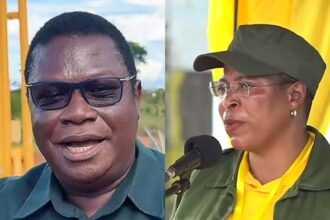
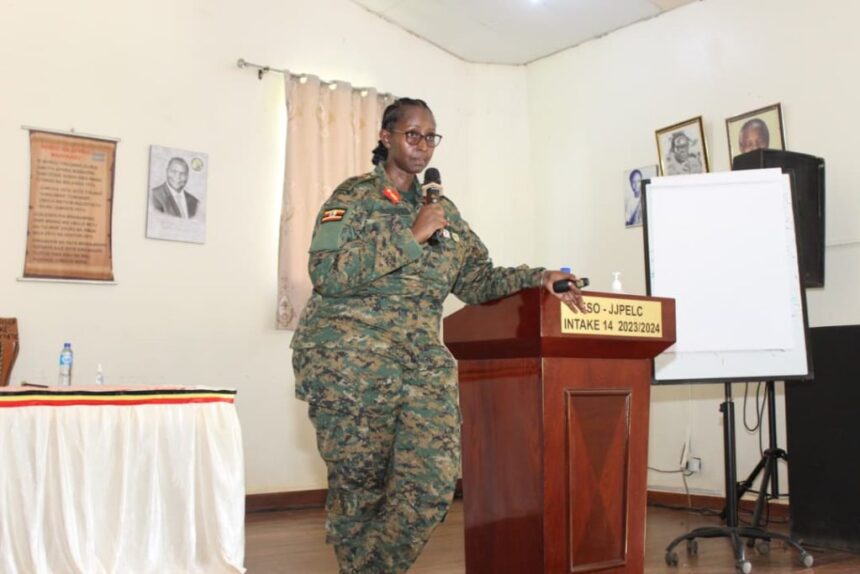
Recently, Brig Gen Charity Bainababo, the Director Women Affairs delivered a lecture on “Gender Inclusivity in Security Forces” to students undertaking the Joint Basic Cadre Development Course and Advanced Psychosocial Course at the Oliver Reginald Tambo School of Leadership and Pan African Centre of Excellence (ORTSL-PACEX) in Kaweweta.
Brig Gen Bainababo commenced with an emphasis on the historical perspective of gender, noting that during both peacetime and wartime, women were often restricted from serving in combat roles or assuming command positions, based on societal beliefs that military service was incompatible with femininity.
She noted that the participation of women in Uganda’s armed forces traces back to the National Resistance Army (NRA) bush war of 1981–1986, where women served as combatants, medics, mobilisers and intelligence operatives, among others.
Following the NRA’s transition into the Uganda Peoples’ Defence Forces (UPDF), their role was formalised.
Over the decades, women in uniform have expanded beyond administrative and medical roles into artillery, armoured warfare, aviation, special forces, engineering and command.
They have been deployed in key regional missions, including AMISOM/ATMIS/AUSSOM in Somalia, operations in the Democratic Republic of Congo, and peacekeeping duties in South Sudan.
The UPDF has since produced female general officers, pilots, engineers, medics, social workers, and commanders in other respective units and formations, marking a steady shift towards broader representation and operational integration.
Brig Gen Bainababo outlined approaches and policies the UPDF has used to address gender inequalities. Policies such as the Gender and Equity Policy have helped streamline measures including the 30 per cent affirmative action for females in the security forces during recruitment and deployment, from tactical to strategic level.
She also highlighted lived realities that still persist in the UPDF, including cultural and social stereotypes, sexism and sexual harassment.
The Director Women Affairs also emphasised how the presence of women in the UPDF has undoubtedly made the force more representative, enhanced its operational effectiveness in complex environments such as peacekeeping, and provided powerful role models.
Brig Gen Bainababo concluded by urging soldiers to maintain discipline, integrity, self-consciousness and good health.
The course drew officers and militants from the UPDF, Uganda Prisons Service (UPS), Uganda Police Force (UPF), and cadres from the Internal Security Organisation (ISO) and External Security Organisation (ESO) services.
Do you have a story in your community or an opinion to share with us: Email us at Submit an Article